
Friday, March 4, 2022

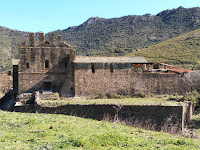
Sant Quirze de Colera

My friend Josep is one of those people with ants in his pants. He is never happier than when he is on the road – small side road, never the major motorway. With him there is no shortage of destinations as he knows every nook and cranny for miles around, including the nearby southern part of France. His problem now is that that cute little Smart sports car of his is in the shop after he had a wreck. It’s been there since before Christmas because it is a challenge to find parts for a rare car. Which is why, these days, he is willing to ride in my plebeian cart and for me to do the driving.

The other day the ants must have gotten the better of him, for he asked me if I had ever been to Sant Quirze de Colera, probably guessing that I had never even heard of it. A medieval monastery that sits in its own small valley in the foothills of the Pyrenees is something one does want to see.

You get there by driving down a small local highway that has no number, and turning onto another even smaller road that turns into a dirt road. Not to worry. If you go slow enough and watch out for the large holes and big rocks, you’ll be just fine.


The ride was lovely. At the road’s end, in a small valley sat this spectacular 12th century romanesque complex: church, cloister, monastery, and a separate parish church. The original benedictine community settled there at the end of the 8th century; the original church was built in the 10th. Already in partial ruins, in 1592 it was closed and in 1598 it was sold and was turned into a farm. It remained in that family until 1994. Sitting within the town limits of Rabós, the family then ceded the property to the town.

The parish church of Santa Maria


Cloister


Church of Sant Quirze interior


When we Americans think of a building being old, we think 200 years. In Europe, those numbers are very different, but people here take it for granted. Our apartment in Tarragona looked out at the old Roman wall of the city. It was built in the 2nd century B.C. The church of Sant Pere, here in Figueres, just celebrated it’s 1000th anniversary. For that matter, Josep’s family has lived here for many generations. On his mother’s side, the family comes from Vilajuiga, not far from Rabós. The name means Jewish town and his mother used to always say (or joke) that the family is probably Jewish. That is probably even more intriguing than a medieval monastery sitting in the foothills of the Pyrenees.


(Photos taken with my cell phone)

Monday, December 27, 2021

Winter Along the Muga River

Yesterday, the 26th, was Boxing Day in England and Sant Esteve here. This rates almost as a second Christmas. Everything is closed. You have Christmas dinner with one family and Sant Esteve with the other and on Sant Esteve you eat canalons. It was also one of those special winter days. The air smelled clean and the sun was out and if it was shining on you, it almost felt like spring. 

Cupcake and I went to walk on the path along the Muga river. Last Tuesday a paddle-surfer spotted a dead body in the Muga a little further downriver, but we were further up where there is a small woods. I’ve been reading a couple of books that talk about Russia and I’ve been listening to Borodin and walking under the trees made me think of the vast birch forests that I’ve never seen except in my mind’s eye when I’ve read Checkov, Tolstoy, and Turgenev. Coming out from the small woods there was a huge carob tree. There the air smelled sweet from the crushed carobs underfoot. I’ll bet they don’t have those in Russia.

Pont Vell (Old Bridge)
A medieval bridge from the 13th century
repaired many times

Cupcake doing one of his two favorite things


Snow-covered Pyrenees in the distance


Sunday, October 31, 2021

A Foggy Morning

Tonight may be Haloween for you, but here it’s La Castanyada, the eve of Tot Sants (November 1), the day when people go to visit the cemeteries, cleaning and decorating the niches of their deceased. For La Castanyada there are parties where people roast chestnuts (castanyes in Catalan) and sweet potatoes and eat as many panellets as they can afford. Panellets are marzipan cookies that come in many flavors, but the traditional ones are covered with pine nuts and are the most expensive. What am I saying? They are all very expensive. And while just about every holiday here has its related special food, often a pastry, for me Tot Sants with its panellets takes the cake.

When I lived in Tarragona, our apartment was across from the cemetery (we thought that would mean it would be quiet, but it didn’t really turn out that way) and we could watch the cemetery fill with flowers from our window. When I came to Figueres, I had to walk to get to the cemetery to see the flowers. And so I went. There are only two entrances to the cemetery and when I got there there were police cars all over the place and the street was closed off. A local gypsy had shot and killed a French gypsy over a drug dispute. In the cemetery. That saga went on for months, with others from the French clan coming here to kill a donkey or vandalize the home of someone in the local clan in revenge. The following year I skipped the visit to the cemetery.


I may go to the cemetery tomorrow, haven’t decided yet. But none of this has anything to do with today’s blog post. Early this morning when I took Cupcake out, it was a normal morning with some clouds. A little while later when we set off for Vilabertran to walk the path, we were fogged in. It is not often we get thick fog here and it turned the usual countryside into an other-worldly landscape.


Irrigation canal


Friday, October 8, 2021

Wetlands in Drought

 Early in September I returned to the Aiguamolls to see the birds. There was visibly less water but there were still birds there feeding. I found the same black-winged stilts, wood sandpipers, moorhens, and little egrets, although maybe fewer than before. I don’t remember seeing ducks.


But when I came back two weeks later, in the middle of September, there was no water and no birds. It was a depressing sight and I haven’t been back since. Where do they go when the ponds dry up?


This is the field where, on one of my first visits,
I found horses and white storks grazing peacefully together.
The greener area was the pond.
.


Friday, October 1, 2021

Wetlands in Flight

 All through the summer there has been very little rain. When I went to the wetlands a month ago, the drought was apparent with the pond visibly lower than it had been just a week before and there were fewer birds. But there were still some there having their lunch: black-winged stilts, wood sandpipers, moorhens, mallards, and little egrets.

So I settled in to see if they were just going to wade around and eat, or if something might happen. And as luck would have it, they did decide to fly a little bit, maybe just to please me because I was being so patient.

Black-winged Stilt


Wood Sandpiper


Wood Sandpiper

Behind: Black-winged Stilt
In front: Wood Sandpiper

Little Egrets