Saturday, November 13, 2010

Catalan Elections

Yesterday was the first day of campaigning for the Catalan parliamentary elections that will take place on 28 November.  This schedule allows 15 days of active campaigning; the 16th day is considered a day of contemplation and no political activities are allowed.  The next day (always a Sunday) the election is held.

This is how elections are handled in Spain, whether they are local, regional, or national.  Other countries may do the same, I don’t know.  Here, two weeks before an election, posters go up, visits are made, and speeches are given; each party gets some free air time during the two weeks; the last day no campaigning is allowed -- it is reserved for thinking it over, and then, finally, off to the polls.  How much money do you think the Spanish spend on their elections compared to Americans?

In order to facilitate the public getting to the polls and then watching the returns on TV, the big Barcelona-Madrid football (soccer) match, originally scheduled for what turned out to be election Sunday, has been rescheduled for the following Monday.  Not the most convenient day of the week for football but hey, elections are important.  Then again, football is important.  Were they were afraid of low public viewing of the game or low public viewing of the election returns?

Sunday, November 7, 2010

The Pope's Visit

Maybe I shouldn’t have, but I did find Pope Benedict XVI’s visit to Barcelona very moving.  After all, I’m not Catholic, not even Christian.  I’m Jewish but not religious.  I’m socially liberal, I believe gays should have all the same rights as anyone else, I do not think people should dictate to women whether or not they should (or can) have an abortion, I think we should all have the right to die when we feel the time has come, and I don’t like church being mixed with state affairs.

All of this makes me an unlikely person to be impressed or even interested in the Pope’s visit today.  But I was.  I was very interested and very moved.  Why?  Well, because I live in Spain where only 14.4% of Spaniards attend Mass regularly, but 73% of them define themselves as Catholic and to them the Pope is a very important person.  Also, I’ve been informed about the details of his visit all week when each day another street would be closed off, chairs set up in perfect rows by scores of volunteers, and this would be part of the day’s news.  Then there is the fact that his visit is important to Catalunya.  Today’s ceremony took place before a congregation of 6500 people including King Juan Carlos I and Queen Sofia of Spain.  Another 50,000 people followed the Mass outside with more than 300 priests there to offer Holy Communion.  His homily condemning gay marriage and the trend for society, this society, to become less religious was unfortunate although not unexpected.  Spain’s socialist government has enabled gay marriage, faster divorce, and easier access to abortion.  But that was not the main reason for his visit.  He came to consecrate Antoni Gaudi’s masterpiece, the Sagrada Familia.  Begun in 1882 and not expected to be finished for another fifteen years, the Sagrada Familia is already an UNESCO World Heritage Site.  Today’s consecration by the Pope lifted it from the status of a church to that of a basilica and, in my opinion, this is a good thing.

The Pope delivered part of his homily in Catalan, an important signal to the world that the Catalan language has merit and is important.  His visit provided the means by which people all over the world could see the interior of the church for the first time.  Antoni Gaudi was a very devout Catholic and spent the last fifteen years of his life devoted only to the building of this huge and unique church, living like a monk on the grounds.  He is buried in the crypt.  He is now going through the process (whether he knows it or not) of becoming a saint of the Catholic Church.  He, I have no doubt, would have been very pleased and honored by today’s visit.  

Tuesday, October 26, 2010

To be, or not to be

It can get boring living out here beyond the pale; there are no concerts, lectures, or art museums nearby.  But government bureaucracies transcend geographical limitations so even out here I can and do find legal hassles.


Soon after I came to Spain I decided that when I was eligible, I would become a Spanish citizen.  Having no intention of going back to the U.S., it would give me the right to vote here (where I follow the issues), and it would make me more a part of the society where I live.  Spain makes you renounce any other citizenship and turn in your former passport, but America does not have that restriction so you only have to apply for a duplicate to have your American passport back.

About a year ago the time had come.  Among other things that were required was that pesky criminal record that I wrote about last April.  Once I had those fingerprints correctly done by the Catalan police, it took another few weeks to actually get the official statement from California.  In fact there was some irregularity to what I had sent, but the sheriff was kind enough to let it go through.  He is a very nice and helpful sheriff and has a standing invitation to come and visit.  I had the statement officially translated into Spanish in Tarragona and added it to the growing mountain of papers.

In the middle of collecting endless documents for my citizenship application, I was also immersed in trying to get myself inscribed as Manuel’s wife in Panama, the country from which he gets his largest retirement pension.  They won’t pay out any extra for me, but getting listed as his wife will give me widow benefits if he dies before I do.

We’ve sent numerous documents to Panama over several years and made many follow-up attempts by letter and phone.  Manuel even went into the Social Security office in Panama City in person last year.  They wanted this, then they wanted that, then they said that something we sent (at considerable trouble and expense) never arrived, even though we had sent it registered mail.  That was my birth certificate.  About three years ago we went to the Dominican Consulate in Barcelona to request a copy of my birth certificate.  They told us that you can only do it in person in the Dominican Republic.  If you can’t go, you can ask a friend or family member to go in for you.  Of course I don’t know a soul in the Dominican Republic.  In hindsight I see the trick they were playing on me, but at the time we were desperate, so we were grateful when the functionary said he would find an attorney who would take care of it for us.  That only cost us about 300 euros.  Now I needed yet another birth certificate for my citizenship application, so I decided to try a different route and requested it online through the Dominican Embassy in Washington.  It cost me $10 plus postage (actually my stepson Manuel graciously wrote the check for me).  No one got rich off of that certificate.

Unfortunately, the social security office in Panama later informed us that I would have to provide a court statement certifying that my name was legally changed from the one on my birth certificate to the one I currently use, the same one that is on my American passport, our marriage certificate, all my Spanish documents, everything that is current.  Not only that, but I have a Spanish court issued statement certifying that I am alive.  If I have documents to prove that I am married to Manuel and up-to-date identity papers that certify that I exist and am currently alive, a citizen of the U.S., and a resident of Spain, why do I even need a birth certificate?  What difference could where or when I was born possibly make in this matter?

Changing my name has been a kind of hobby of mine.  Possibly it has to do with an identity problem – something I’ve evidently been plagued with over the years.  I’ve changed my first name, my middle name, and my family name, and the latter I’ve changed more than once.    But some years ago I settled on what I use now, having my father’s original last name as my middle name and my first married name as my family name.  In fact, I’ve used this family name twice as long as I did my maiden name (and my maiden name was not our original family name because my parents had changed it when we immigrated to the U.S.). 

So I sent Panama an affidavit stamped and sealed by the American Consul in Barcelona explaining and testifying to the name change.  But it wouldn’t do.  Nothing short of a legal statement from an American court would do.  I thought of applying for the court order myself using a Nolo Press do-it-yourself book, but part of the procedure is a personal appearance in court and besides you are supposed to be residing in the court district.  Since it wasn’t straightforward, I asked Howard, an old friend of mine from Los Angeles who practices law in the Bay Area to help me.  So I am now in the middle of trying to obtain a court order certifying the legal change of my birth name to my present name.  It has cost me a lot of time and may end up also costing several hundred dollars.  But after I obtain the court order, I’ve promised myself never to change my name again.

Back to my Spanish citizenship.  In August, when I thought I had all the required documents, I went in to the government office in Tortosa.  But of course I didn’t have everything after all.  So I went away and worked on assembling the rest.  And finally, last week I went in with the full complement of papers.  They went through it all and could find nothing missing except the marriage certificate issued here in Spain, certifying our American marriage.  But I had the official signed and stamped receipt for having filed the request for it, and that would suffice until the real document is produced.  It seemed that everything was, after all, in order.

I thought we were finished, but they still had one small surprise in store for me.  Just as I was getting ready to leave, the clerk mentioned that once my citizenship was approved, my name would be changed.  What?  I don’t want to change my name.  Yes, my name would be changed to the Spanish way of doing last names.  After all, at that point I would be Spanish, and Spanish family names are in two parts: first the father’s family name, and then the mother’s.  What a nightmare!  I didn’t grow up with my father’s real last name; he had changed it when I was two.  Some years ago I adopted my father’s real family name as my middle name, and it now appears on all my official papers, but I’ve never used it as my last name.  I can’t even pronounce my mother’s maiden name properly.  Besides, the one she put on my birth certificate was not her real maiden name.  She had been using this one during the War as a kind of protection because her own was so obviously more Jewish.  I guess changing names is an inherited family trait.

Now this new development presented some serious problems for me.  First of all I am in the middle of a long distance legal process to get the name I use officially certified, court-ordered, and recorded.  Then the next thing I do is go change it to something else again!  Apart from the fact that I don’t like being dictated to, changing my name again seems to me to be asking for a lot more trouble down the road.  And besides, my name is part of my identity.  I like my name.  I chose my name.  It’s been mine for forty years.  It’s who I am.  Who are these people to say I must change it?

I left the Civil Register office with all my documents in hand, telling the clerk that I would have to think about it.

Friday, September 24, 2010

La Sardana

When I moved to Barcelona I learned to dance the sardana, the Catalan national dance. I found a place that holds a dance every Friday evening, with lessons for those who want them. Manuel didn’t want to go, so I started going alone and after a while I got to where I could do the sardana passably, at least to where I was usually headed in the right direction on the appropriate foot at the right time. It eventually turned out that learning the sardana became much more than just learning the steps of a dance, but more about that another day.


The sardana is danced in a circle and entering a circle has its protocols. The man to the left of a woman is assumed to be her partner (although partners are not required), so one never enters between the pair. You also don’t enter between a man and the woman on his left (I don’t know why) unless you are a couple or you have no other option. It is always OK to enter between two women. The unlimited number of women in a circle allows any woman to dance whether or not she has a partner. So, once I learned how, if I wanted to dance, I just went to a place where they were having sardanes and joined in a circle.

Next, the common etiquette is to join into a circle of people who dance at the same level of knowledge and physical ability as you. That makes it difficult for the complete beginner who doesn’t know beans about how to do the dance. But there are those kind souls who will take a newcomer aside and show them the steps, although it takes more than a few minutes to really learn the dance (simple as it may look) and if you dance badly, you spoil it for the rest of the dancers in your circle.

At first I had tried to pick up the steps by following behind someone in a circle or joining into a group of gent gran (elderly!). But even with the gent gran I was a little bit lost. For one thing, inexplicably, they would all suddenly stop the step they were doing and then start in again either with the same step or with a different one, sometimes on the left foot, and other times on the right. Figuring it out seemed like a great puzzle to which I didn’t have a clue, except that the stops coincided with stops, or breaks, in the music. But every time I went, I heard different melodies. Clearly everyone knew when to stop, when to change steps, which foot to start out on again and exactly when to finish. Had all the hundreds of dancers committed every piece of music to memory?

On the other hand, dancing with the gent gran could get a little boring.  Quite frankly, some of them schlepped. Those groups of younger people who danced better seemed a lot more interesting -- instead of shuffling they bounced, sometimes they jumped, their foot movements were more precise and pretty to look at, and even though it was the same dance, there seemed to be more variety to what they did, certainly more elegance. It was clear that I wasn’t even close to their level of dancing, but I had my aspirations, so I decided I would take lessons which eventually led me to the Friday evening dances.

There are only two basic steps to the sardana: els curts (the shorts) and els llargs (the longs). You join them together with a combination of two- three- or four-step cambis (changes). The dance goes like this. On the numbered count you lift your knee and point your toes down and then tap the ground with the tip of your shoe. The following step will be with the same foot. Say you’re starting with your left foot, which is how the dance always begins, the curts go ONE, step, step, step, TWO, step, step, step, and you’ve moved a little to the right, then you’ve moved back a little to the left. Danced well, you have placed your feet very close together and on the third step you cross one foot in front of the other. After more than three months of practice, I was still tripping over myself every now and then if I didn’t concentrate on what I’m doing. Were my feet too big? The Catalans never trip.

Llargs go ONE, step, TWO, step, THREE, step, step, step, also going back and forth and ending up pretty much where you started. If, in addition, you also bounce once on your planted foot, keeping time to the rhythm, every time you point or step, then you are dancing rather well. If you dance entirely on the balls of your feet, bouncing but never touching your heels to the ground, then you’re a good dancer.

Every circle has a leader who calls out the cambis. That person is counting every beat of the music. The person who counts only has to know in advance how many tirades (sets or layers) the sardana has. Unless otherwise announced, the cobles always play sardanes of ten tirades. The leader counts the first set of curts, and later the first set of llargs. They can tell the end of a set because of a break in the music. After that, the leader keeps right on counting because all tirades of curts will have the same number the first set had, and all the llargs will have the same as the first set of llargs, and the leader has to keep counting to know when to call out the changes and the stops. The count for a set of llargs can number up into the eighties. That’s a lot of counting.

I have attended a couple of sardana events where there was no one in the circle who could count. You can’t dance properly if no one can count -- part of the joy of the dance is ending up exactly with the music.

Sometimes a circle will also have a second leader. This is the stylist. The stylist calls out when to bounce, to bounce more, to jump, to jump higher, to stop the jump or the bounce, and so forth. Because a well-danced circle constantly bobs up and down at different levels of intensity that complement the music, and everyone who dances knows when to start, when to bounce, when to jump, and when to stop, each circle looks like a living organism.

There is a sameness about sardanes that would boggle the mind of many. People who need constant stimulation of new and fast-moving things would probably not like the dance. If you are the type of person who needs to go to a new restaurant every weekend, the sardana might not be the dance for you. There is only one set formula for the dance, no opportunity for improvisation to speak of, and even though each song is different, many of them have melody fragments so similar that if you know the repertory, you still might initially confuse one for another. They all have the same structure, and your feet always do the same two steps.

So why do Catalans love the dance so much? Well for one thing, it has a subtle beauty when done well and the whole circle moves like one unit. Also, when you look across a plaça where many circles are dancing, it looks like some sort of musical mass movement and all the people know that they are participating in something intrinsic to their culture. The music too, once you get used to the slightly whiny sound of the gralles (a unique, Catalan wind instrument), has its own unique sound and if that sound does not hurt your ears, you quickly start to have your own favorites, both for dancing and for listening. Yes, listening. They give sardana concerts where you sit in a hall and just listen. Some people – diehards -- attend these.

Going to sardanes is as much a social event as an opportunity to dance and most people come for both. And finally, people enjoy doing their national dance not only because they consider it beautiful or fun or good exercise, but because they weren’t allowed to for so many years. So it’s a little like the difference between going out to a new restaurant every weekend, as opposed to going to your grandmother’s house every week for Sunday dinner. The sardana is definitely Sunday dinner and learning to dance it became an invitation to join the family.

I have danced very seldom since leaving Barcelona, but on this last La Diada (the Catalan national day, 11 September) I went to a nearby village where I had heard there would be sardanes with a live band. It took a bit of poking around sausages, cheeses, and handmade soaps in a medieval-style fair, but I found it. I sat through the first one then joined into the second. I must have said something to this woman because after sitting out the third, she came up to me and asked if I wasn’t going to dance any more, that I danced very well. Her name was Maria and she was from Lleida, a city she said I must visit to see especially the cathedral. Wasn’t that nice? So, the people were friendly, the music was wonderful, and the whole experience reminded me of why I loved it here in Catalunya when I first came. It made me feel alive again.


Saturday, September 11, 2010

Catalan Castles

On 11 September 1714 the Catalans, who had supported the Hapsburg claim to the Spanish throne, surrendered to the Bourbon victor. Oddly, this monumental defeat marks the national day of Catalunya. La Diada is celebrated with flags, wreaths commemorating the heroes of that war, speeches, Catalan poetry, and music. Last night I listened to the annual La Diada address of the President of the Generalitat (Catalan government), and later today I plan to go to dance sardanes, the Catalan national dance.


There is talk and there are posters proclaiming that Catalonia is not Spain, and if anything supports that sentiment, the sardana surely does. Compared to the iconic Spanish national dance, flamenco, it is at the opposite end of the dance spectrum. Everyone knows what flamenco music sounds like and what the dance looks like – fiery, almost violent, full of sexual innuendo and manifesting individual pride. Contrast that with the sardana, and you would assume that the two dances came not only from different countries and cultures, but possibly from different planets.

To dance the sardana is to bob up and down, doing one of only two patterns of steps, sometimes with arms down and other times with arms up, in a circle, with no partner required, no evident leader, no individualism, no fire, and definitely no sex. It is staid, some think it is boring, it is danced totally in unison, it has no variety. But when done well, a circle of dancers looks like one living, bobbing organism, and I happen to like that. It is symbolic of what you see a lot of here – community spirit.

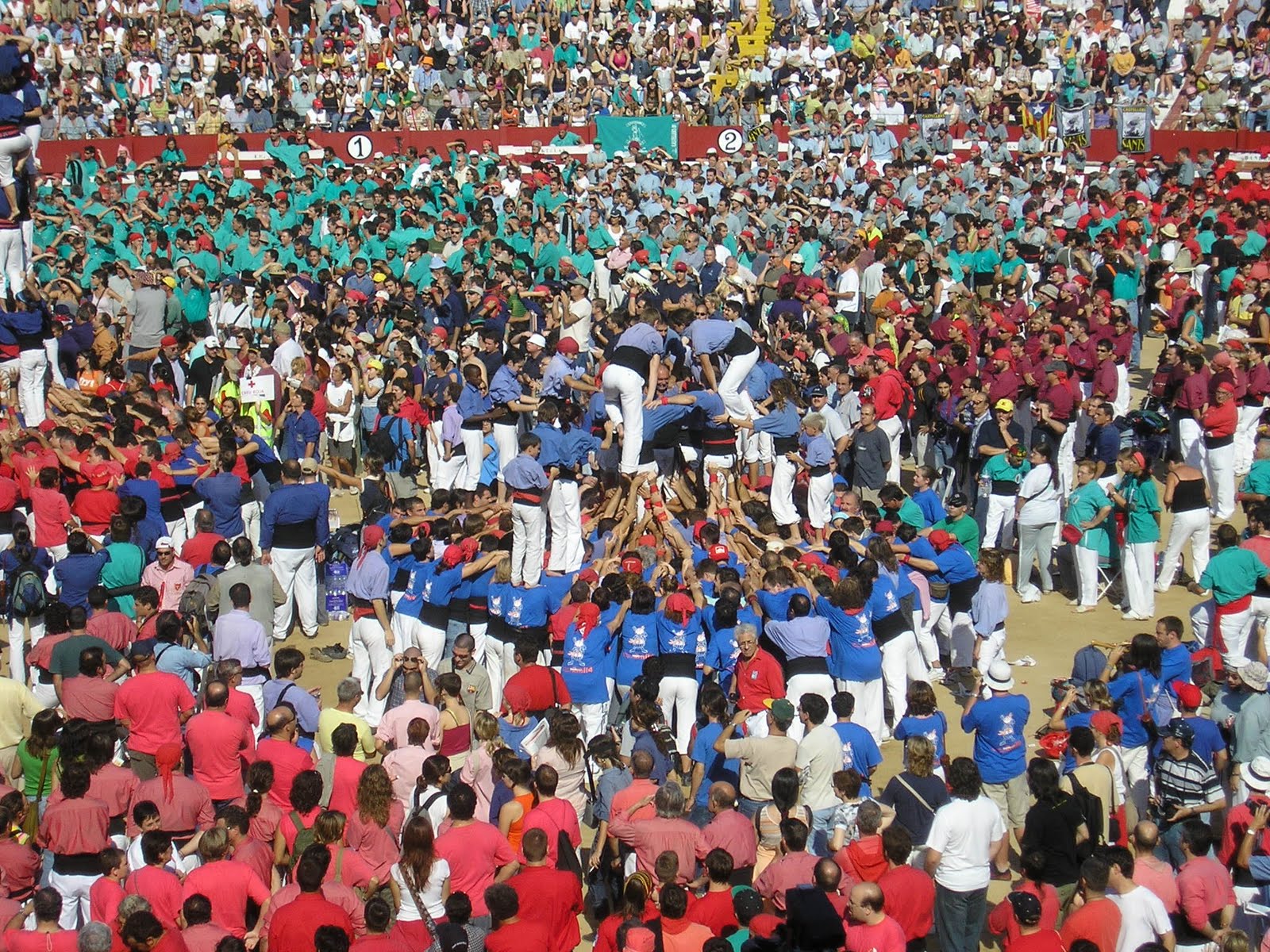
Another excellent symbol of community spirit is the uniquely Catalan sport called castells. Castell means castle in Catalan -- you could say these are castles or human towers. The towers can reach as many as ten storeys. Each storey is made of people who have climbed up onto the shoulders of those below while accompanied by the music of gralles, a whiney-sounding flute that sounds like a sick seagull.

Castells are formed on a square base of four very formidable men, who use their arms to lock themselves into an extremely tight position that will directly support the tower. The weight of as many as nine human storeys, each of two, three, or four persons, will go up above them and will bear down directly on them. The core four are then surrounded by others – dozens of people, sometimes over a hundred -- who hold onto them and each other and provide the buttressing to help the four anchors withstand the weight and pressure from above. This construction is called a pinya, literally a pine cone or a pineapple. To fer pinya (make a pinya) means to work or band together towards some common end. Sometimes a second pinya is formed above the first. Bear in mind when you look at the photos that you do not see the base pinya in the sea of people on the ground.

Once the pinya is deemed solid (by the cap de colla, the director or head of the group) the persons who will make the tower begin to scramble up. Storey by storey they set themselves up, each layer climbing up the backs of those before them and doing it all to the traditional music played by a drum and gralles (small wooden flutes). The castle must be made as quickly as possible – the whole thing takes three or four minutes -- for the weight bearing down on those below cannot be withstood for long. The castle is finished when the top person, called an anxaneta who is usually a small child about 7 years old, holds up his or her hand to signal completion, but the whole thing is not concluded until those who went up all climb back down.

When I watch them make castells, whether in person or on television, they give me goose bumps and inevitably make me cry. It’s an incredible cooperative effort, so suspenseful to watch, and I always find it very beautiful and moving.

This is THE typical Catalan sport, unique to Catalunya, and is one of the things that sets it apartment from the rest of Spain where the equivalent sport is to torture and murder bulls. Ironically, I took these photos at a special competition that was held at the Tarragona bullring a few years ago! When I wrote on this blog some months ago about the move here to forbid bullfights, someone posted a comment saying that the Catalans are against bullfights only because they want to appear different from other Spaniards. But I beg to differ. Catalans ARE different. Their national sport, the castells, and their national dance, the sardana, contrasted with bullfighting and flamenco, typical in the rest of Spain, demonstrate that difference perfectly. In both there are no stars, no soloists. Both are cooperative efforts of people doing something together and in the making of castells, it is for the simple pleasure of creating something wonderful that lasts only a moment.

Making castells is a popular sport in Catalunya -- children and mature adults all belong to the teams.  It is not nearly as big as soccer, but important enough to be covered regularly in newspapers and on radio and TV. Many towns have a team, the bigger towns sometimes have more than one. They hold competitions throughout the season where they earn points for the difficulty of the construction and whether or not they put it up and then brought it back down without mishap. They always participate and are a highlight in the festes. Castells are one of the grand cultural manifestations of Catalunya.  There is a video on UTube about the castells, narrated in Catalan, if you don't understand Catalan you can still enjoy the images.  If you want to take a look it is at http://www.youtube.com/watch?v=0N6gYDTXk1U

Wednesday, August 4, 2010

Party Pooper

Although not much of a party person, I’ll go to one if invited, there being little else to do. I’m one who prefers the kind of conversation you have gathered around a table with food (and wine). I’m clumsy at making small-talk and then gracefully moving on to the next person while trying to balance a plate of food and a glass of wine, eating, drinking, and talking, all while standing.


Parties can be challenging and they can also be dangerous. At one that I attended last April, an English woman of a certain age, an acquaintance – friend of friends whom I have met many times at such events, we have never hit it off – told me, when I protested that I wasn’t happy with my hair cut, that I should have my face lifted. Not being quick on my feet, I told her I couldn’t afford it. But I mean really, what does one say to advice like that?

When I drove up to a recent party, I pulled in to park next to a couple I know who were just getting out of their car. However, they are young and apparently living life in a hurry and didn’t wait the extra minute so that we could all walk up the hill together. Not an auspicious beginning to a sociable event, but never mind, there was still hope for spending a pleasant and perhaps interesting evening.

In the emailed invitation we were asked to bring a tapa. Not having a kitchen in which to cook, I brought three store-bought pates and little toasts to spread them on. Upon entering the garden where the party was taking place, there was no sign of the host or the hostess. I may not be a big partygoer, but I have seen how it is done in the movies where guests are announced by the butler. I thought in less formal circumstances it was usual to be greeted by a host when one enters, or offered something to drink soon afterwards. But here one simply found one’s own way. I went to look for the hostess and begged for a plate, unloaded the three pates, and headed off in search of stimulating conversation.

People of many nationalities were in attendance: English (the majority), French, Swiss, Dutch, and Catalan. As far as I know, there are only four or five Americans living in this general area: me, a couple I have never met, and the couple who were hosting this party. When they first arrived here, I thought we would have a lot in common and would become friends. But once they settled in they dropped me and threw away my phone number so that now I only see them when there is some group activity.

I engaged in an initial short chat with a Catalan woman whose daughter was spending time in the U.S. As is often the case with roaming Catalans, she doesn’t plan to stay there, preferring to return to family and friends here. I made what I hope was a graceful exit and then spent most of my time chatting with two French women, one of whom I vaguely know from the arts and crafts fairs where we both sell – she, jewelry made of ceramic beads that she makes (very nice) and me, cards I make from my photos. The lady I know is French while the other turned out to be French-speaking Swiss. I didn’t realize the French-speakers were in the minority in Switzerland and that there were three official languages: Swiss-German the big majority, then French, the bigger minority, and finally Italian, a small minority, spoken by a handful.

The Swiss lady spoke French and a very broken Spanish. The French lady spoke French and decent Spanish. I don’t speak Spanish but I do speak Catalan. In spite of the Pimsleur French course I’ve been working on, I can’t manage to say anything in French when I try to use it in public (my brain goes to the Foreign Language section and only Catalan comes out), but I can at least understand some French. So I spoke Catalan, the Swiss lady spoke mostly French (from time to time she would throw in pidgin Spanish and become almost completely unintelligible), and the French lady would speak sometimes in French and sometimes in Spanish and translate for one or the other of us when needed. We all got on just fine.

It was a bunch of work but we managed to converse for quite a while in this trilingual manner. Although tiring, it was good mental exercise, and I do need all the mental exercise I can get -- I’ve already forgotten the French lady’s name, but the Swiss lady is Giselle. Like in Swan Lake, she said. I may be wrong, and didn’t want to question her about her own name, but I thought it was Odile in Swan Lake; Giselle is another famous ballet and was one of my mother’s favorites. Good I kept that to myself because eventually I was invited by Giselle for a real Swiss fondue, ladies only, but not until December when the proper cheese can be obtained. I’m hoping that I will have moved away by then, and Giselle says she is trying to sell her finca (a country property) and would like to move to Albi. But in the more likely and unfortunate event that we will both still be here, I will be very pleased to go. I love fondue. Takes me back to the 70s – to my youth when we all had those fondue pots we were given as wedding presents. Maybe by December French will actually come out when I try to speak it.

But danger lurked at this party too. I was introduced by the parking lot woman to another young English woman whose name escapes me. Hola, she said. Hello, I answered. DeVOra she said. Your name is very harsh, she told me. It sounds like devour. That isn’t very nice, is it? Nice meeting you, I said and walked away. Moving on suddenly became easier.

I hiked over to where my English friends were sitting, ate and chatted with them. Unlike me, some of the invited guests had actually prepared food, some of which was very good: a fine potato salad with tuna, seito (tiny marinated fish), several good looking omelettes (all of which I passed on, afraid of my egg allergy acting up), curries, and a dynamite bean salad. I really wanted the recipe for that bean salad, but how would I find its maker among all these people, most of whom I didn’t know? So I put the question to those at the table and struck gold. Angela (who makes lovely pearl earrings and also sells at the arts and crafts fairs) was the cook and was happy to share her recipe with me. But good luck finding the Thai red curry paste here in Spain. She buys it by the tubful on visits back to England.

Before heading for home, I went back to spend a few more minutes with my new French lady friends. The people at these parties come in many nationalities and in all types. It’s great when you can make the acquaintance of the ones with whom you click and not let language be a barrier. And for the others, well maybe chatting briefly and moving on isn’t really such a bad idea.

Friday, July 23, 2010

Summer Digs

My summer living quarters are in a small in-law apartment at Eve’s. One of the disadvantages of living in a home I can’t afford is that I must move out of it and stay elsewhere every summer while I rent it out to tourists. At least it’s possible to do that here, this being a popular seaside resort. Besides having to pack up and store all those special personal possessions that I don’t want strangers messing with, it also gives me the feeling of not having a permanent home. Except for my cats, my most treasured possessions don’t live with me. I keep them safely stored away, waiting for the day when I have a normal life, when I don’t have to share my home with strangers and can keep my treasures with me – things like my good dishes, the electric candle lamps that used to flank the family fireplace, the Lladro dancer figurine I once gave to my mother for her birthday, and photos of my parents. It might be different if I were to go somewhere for a real vacation – the South of France, perhaps? – but I can’t afford that and I have to be here to manage things, so I simply move out, take my cats with me, and go to stay nearby. I was very happy when Eve told me I could use this apartment, thus allowing Manuel, with whom I would otherwise stay, to continue to enjoy his little space on his own, without three intruders.


I feel as if I were at camp for the summer, surrounded by pine trees like up in the San Bernardino Mountains, except these are Mediterranean pines and I am a few hundred meters from the sea. I have only one room with a bathroom, but it’s a good-sized, spacious room with a kitchen counter and sink and mini refrigerator. Although I can’t cook, I brought my espresso machine and toaster with me so for breakfast I can make my morning espresso (with foamy steamed milk) and toast. For lunch I make a salad, during the day I munch a piece of fruit or down one of those yoghurts that is supposed to lower your cholesterol (I don’t believe it really does much of anything, but I like the stuff), and in the evening I snack on some bread and cheese, just like I do at home, having cut out evening meals years ago.

Except for the lack of cooking equipment, television, and internet, I don’t really miss much and in some ways feel more comfortable in this much reduced space. It is only a little smaller than the duplex I once owned on Bancroft in Berkeley where I felt like Heidi. I think I could live happily enough without a television, but I very much miss having internet access at home. I normally spend time online reading and writing email, participating in two online book groups, writing my blog, participating on expat forums, reading through Vincent Van Gogh’s letters to his brother Theo, looking up all kinds of information, and conducting the rental business. Now, if I am desperate to do something other than read or study French, I pop a DVD into my computer and watch a film. Staying here is good practice for figuring out what kind of space I might buy when I finally am able to sell my villa and move. A very small apartment would suit me fine, although I would probably prefer that it have a separate bedroom. When you have two cats, it is good to have a space where you can either lock them in, or lock them out, depending on the problem at hand.

The fact is, when I’m with my cats, I feel I’m at home. Minnie and Felix are so happy here that I’m not sure they will want to go back to our house in September. They now have a huge garden to explore and after the initial fear passed, have been having a fine time although they play less, probably because of the torpid weather. Contrary to the common wisdom of not letting cats out for the first two weeks at a new home (something I have never done), I let them out the day after we arrived. Frankly, I have never understood the universal description of cats as solitary, independent creatures who are more attached to places than to people. All my cats have been completely attached to me and have been very social (if somewhat shy of others), and Felix, the feral, wounded cat who lived his first year and a half on the street and who I recently adopted, is the most affectionate cat I’ve ever had.

My garden at home is mostly lawn – a very green, nicely kept lawn bordered by cypress trees around three sides of the perimeter and oleander (now in bloom) across the back wall. Near my dining room I have a small area planted with lavender, roses, gazanias, and rosemary. Basically it is a small and simple, manicured, green garden.

Here the garden is very large and very different. Brian, Eve’s husband, used to garden and clearly spent quite a lot of time at it. But he is now in a care home with advanced Alzheimer’s and the garden is regressing towards a more natural state. This is a good thing for the cats. They like adventure and my small, manicured garden doesn’t provide much of that.

I’ve only moved a few blocks and yet the atmosphere is noticeably different with new sights, sounds and smells. There are several pines around the house plus more on all the adjoining lots, creating a small neighborhood pine grove. Perhaps because of all the pines, the birds that come into the garden are different. At home I get mostly sparrows and some swallows (that skim the top of my pool for water). Here there are many wood doves and magpies. Eve also has many other types of trees, grape vines, cacti, and countless stone- bordered beds running amok. I read sitting at my front window where in the early evening, the aroma of jasmine starts to drift by, a pleasant, new experience for me, but by late evening the scent becomes overpowering. I probably really am meant for an urban life.

Among the new sounds, the most frequent is the cooing of wood doves that favor the surrounding pine grove. Then there is the chattering of magpies, and finally the cicadas. I love to stand at the back kitchen window and listen to them, that chirping somehow transports me to Marcel Pagnol’s Provence and the films My Father’s Glory and My Mother’s Castle. The annoying noise here is the public announcements, broadcast from our town hall, that come in over loudspeakers scattered throughout the neighborhood. I get them at home too, but at my house they aren’t as loud. Here, when the announcements begin, they are so overpowering you can’t hear anything else. Besides being horribly intrusive, the announcements are a waste of time and a needless source of noise pollution. Monday through Friday, we are told twice at each broadcast all the news the town hall wants us to know including that the new underground parking lot is available for yearly rentals, what special activity will go on at the weekend, and which pharmacy this week is on 24-hour call. It goes on for five or ten minutes. The town runs a radio station; why don’t they announce these things there? How about posting it all, quietly, on one or more bulletin boards? Does anyone ever actually listen?

It’s nice having a neighbor who is also a friend. No need to arrange to meet, we see each other on the way in or out and sometimes just pop by to chat. Of course Eve has television and invited me over to watch Spain play Holland at the World Cup final. We ate snacks while cheering Spain on (they played way better than Holland and we were quite loud for two mature ladies) and toasted the new champions with cava. So summer, like so many things, is full of the good and the inconvenient. But I try to follow the example of my cats and regard it as yet another adventure.