Monday, April 13, 2015

Meet Cupcake

In January a local dog rescue group called me to say that a small dog in a nearby shelter would be having surgery that week and since the weather was so cold, could he come to stay with me to recuperate in a warm home?

They sent a photo, but the photo wasn't important. My vet had advised that I not adopt a dog because one of my cats is chronically ill and living in a stressful environment would likely take a toll on his health.  But I have always wanted to have a dog, and I finally decided that I could give it a trial.  If the sick cat didn't seem too stressed, the dog could stay.

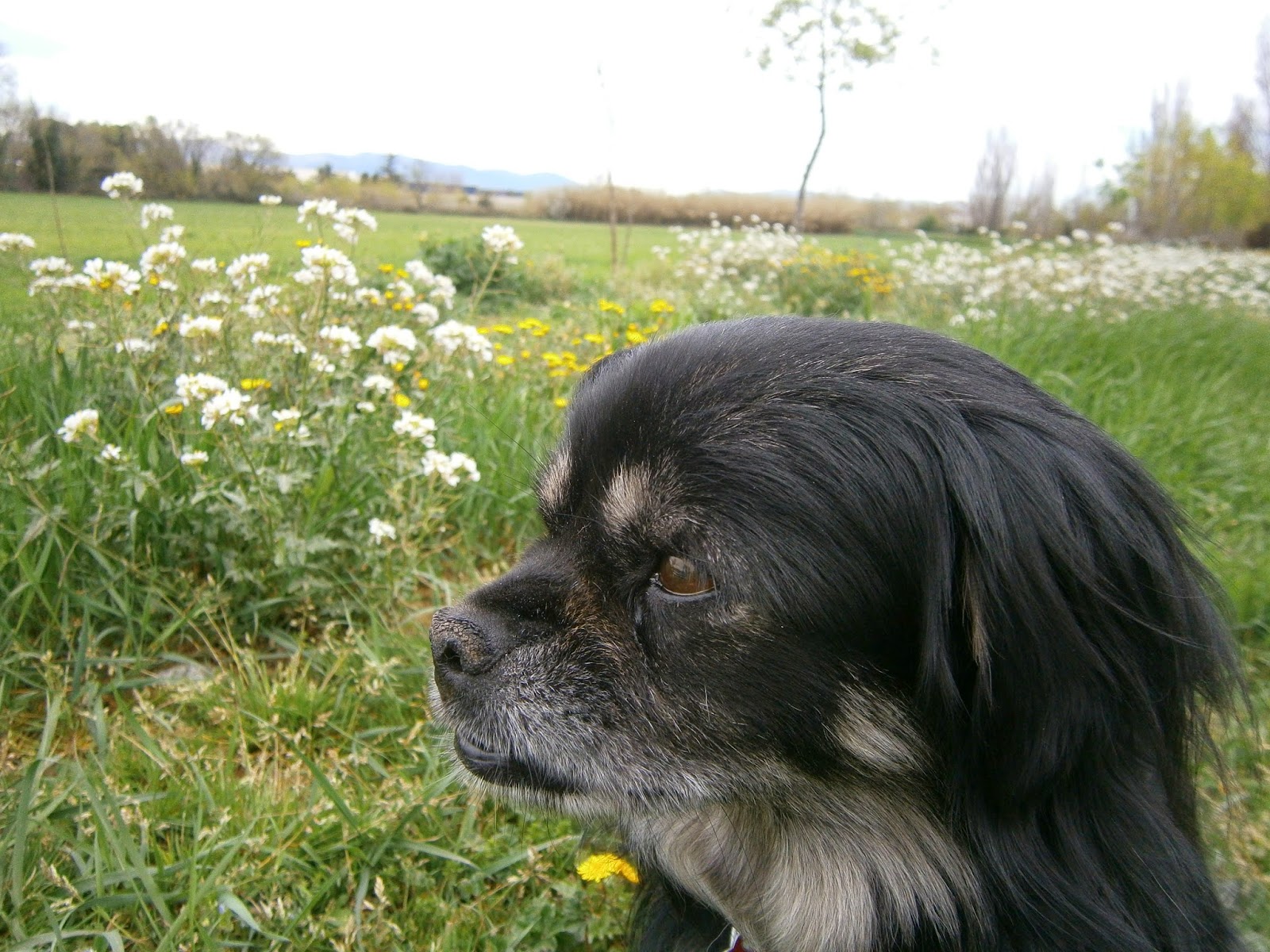
Meet Cupcake.


Life changes when you adopt a dog.  First of all there are cute little jackets and hats to buy, doggy costumes for Halloween, doggy shampoo, doggy booties for the cold.  Just kidding.  The main difference is that I now have a shadow who follows me around the house and I walk (outdoors) much more than I ever have. There are the compulsory three walks a day, some of them turning into outings to a nearby village, a multi-use path, or the beach.  


Occasional visits to the dog park have become a daily event, and one highly prized by Cupcake.  He loves the dog park.  He was a little shy in the beginning, but with each visit he’s gained confidence and blossomed, running with small and large dogs, and in spite of his short legs, running even with the greyhounds.  

The dog park is not a very large space but the dogs have enough room to run if they don’t mind going in circles.  Since most people live in apartments, it gives the dogs a chance to run, be outdoors, and to socialize.  And, as it turns out, it also gives the owners a chance to socialize.  It’s the most socializing I’ve done in years.

Cupcake & Co.


And what do you know.  The cat likes the dog far more than the dog likes the cat.


Monday, March 2, 2015

Paris in the Drizzle

Paris was good for me.  It was good to walk in the place where so much of what I've read took place.  It was good for my tummy and for my soul. 

One evening, with Elaine and Jin, there was the outstanding fish soup followed by to-die-for small steamed (Spanish) mussels done the French way with wine and lots of butter.  As someone once said, you can never have too much butter.  With the whole group there was the outstanding galette (salty crepe made from buckwheat flour) with cheese and bacon and I-don’t-remember-what-else in a neighborhood creperie that Brigitte, our fearless leader took us to on the day when we braved the rain climbing the hills of Montmartre.   If my galette didn’t recharge my batteries, the apple crepe with Calvados that I had for dessert certainly did. 


In fact, I felt so fortified that instead of inspecting the two churches on offer at the top of the butte, I stood in the drizzle arguing with our lecturer James about whether Vincent committed suicide or was shot by someone.  I am of the latter opinion but James, who is a graduate of the Sorbonne, holds a Ph.D. from Southampton-Solent University, and is an expert on art history, didn’t agree.  Even experts can be mistaken.

Passing by the apartment building where Vincent van Gogh lived with his brother when he came to live in Paris, James gave the group a brief history of the artisst.  A history full of errors.  Vincent went to teach in England before he became an evangelist in Belgium.  Maybe it isn’t important the order of his jobs, but it is important to mention that he couldn’t keep any job, not even his first one that had been for an art dealer – a family member.  His whole working life was a failure.

James also said that Vincent was mad.  That he had shown symptoms earlier and then had the crisis when he cut off his ear.  Madness ran in the family.

In the 1880s people talked of madness because there were many illnesses that had not yet been defined.  Look a little further back and madness was thought to be the work of witches or the devil.  But no one talks of madness now.  Now, people suffer from schizophrenia, bipolar disorder, epilepsy, and other illnesses that doctors couldn’t diagnose or didn’t have treatment for in Vincent’s day.   Vincent’s illness had a diagnosis, even if it wasn’t known at the time.  A recent theory was that he had bipolar disorder, but it has lately been convincingly argued that he suffered from temporal lobe epilepsy.  Ironically, epilepsy was the diagnosis of Dr. Reyes who initially treated Vincent in Arles when he mutilated (but did not cut off) his ear.  Unfortunately, even though Dr. Reyes was probably correct, there was no treatment for it then.

James went on to say that Vincent went to Avers-sur-Oise in order to stay with Dr. Gachet and because there was an artist community there.  Vincent’s brother Theo knew Dr. Gachet, who was an amateur painter and art collector, and had arranged for him to stay with the doctor in order to receive treatment for his illness.  There was no artist community.  When he arrived Vincent discovered that the doctor was not able or willing to have him in his home, so he went to stay at the village inn. 

Some of these erroneous bits weren’t really important, but all together they painted a picture taken out of Lust for Life rather than any real biography of Vincent. 

The most important error, in my opinion, was to say that Vincent committed suicide.  There is convincing new research presented in the excellent book Van Gogh: The Life by the Pulitzer Prize-winning authors Steven Naifeh and Gregory White Smith that says that Vincent did not kill himself, but that he was shot by someone – probably by a wealthy teenager whose family summered in the village and who used to taunt Vincent.  Earlier research pointed to the same conclusion.  If he had shot himself and walked back to the inn, what happened to his painting kit?  His easel, paints, brushes, and canvas were never found.  And the gun?  Where did he get and what did he do with the gun?  That was never found either.  He hadn’t been out in the wilderness; he was in the cultivated fields by a village and yet none of these things have ever been found.  But besides these questions, there is new forensic evidence that makes it very unlikely that the gunshot could have been self-inflicted.  (Link to article)

All these myths being presented as facts annoyed me enough to stand in the drizzle and argue.  Vincent is one of the world’s most important artists who never found the love and understanding he sought during his lifetime (except from his brother) and deserves the respect to be presented accurately.

Calvados crepes and Vincent aside, my food highlight in Paris was our dinner at Miss Lunch, a tiny restaurant and food shop run by Claude, a food artist.  The food was good but Claude was the tour de force of that tasty and very entertaining evening.


Other highlights?  The Van Gogh and the Art Nouveau collections at the Musee d’Orsay, walking in the Marais, seeing the Allee des Justes with the names of those brave people who had helped French Jews escape the Nazis, the evening boat ride on the Seine, paying my respects at Colette’s tomb, just BEING there where so much of what I’ve read about happened.


I took no food photos at meals.  In fact, I took fewer photos than usual during the whole week, partly because of the weather, and party because I didn’t want to be bothered.  Of the ones I did take, a good number turned out to be rubbish.  I think if I want decent church interiors and night shots of the Eiffel Tower and Notre Dame Cathedral taken from a moving boat, I need to take my better camera that has more possibilities for settings.  And I never did make it into Shakespeare and Co.   I guess I’ll have to go back.


Friday, January 2, 2015

A Tourist in Paris

Paris.  If I had known, I probably wouldn’t have gone.  I don’t mean the grey, wet, and very cold weather I endured there.  I had warm clothes, warm and comfortable boots, my beret, gloves, and an umbrella.  I was invincible.

I’m talking about the sudden and unexpected dip in my income that came about soon after I had already taken the funds out of my retirement account and booked.  There could be no refund.  It would be ridiculous not to go, n’est-ce-pas?

I’d never done an organized tour before – not even a day trip.  This tour was with Road Scholar and was called “Independent Paris: People, Places, Culture”.  Would we be led around like ignorant sheep?  Would the others in the group be good company?  They said the energy level required was fairly high and there would be a considerable amount of walking.  Would I be able to keep up?

None of it was a problem.  The group was varied, I was fit, and the tour was well conceived and well executed.  Brigitte Young our group leader was very good, and James M’Kenzie-Hall, our lecturer/guide was intelligent, knowledgeable, well spoken, and witty (in the best British tradition).

I came by the Spanish/French fast train, to the Gare de Lyon and arrived at the hotel (Le Patio de Sant Antoine) in plenty of time to unpack and then go to the welcome orientation at 5:30.  During our introductions there was one husband who said he had come because his wife made him, and indeed, I believe he managed not to enjoy himself.  In Paris!  Of the sixteen people in our group, six were married couples and the rest of us had come alone.

We would have lectures at our meeting room in the hotel and then off we would go to see the sights and visit museums.  While out and about, we would be connected to our guide by a wireless audio guide system, each of us having an earphone wrapped around one ear.  This allowed James to continue his lectures as we walked and eliminated the need for the leader to wave an umbrella or flag in order to keep us together. 


The first morning we had a coach all to ourselves and were driven around for an overview of Paris with one stop for a photo opportunity at the Eiffel Tower.  When that tour finished the driver had no choice but to pull up to stop on the left of a busy one-way street, leaving us to get off into traffic.  That was our first adventure.

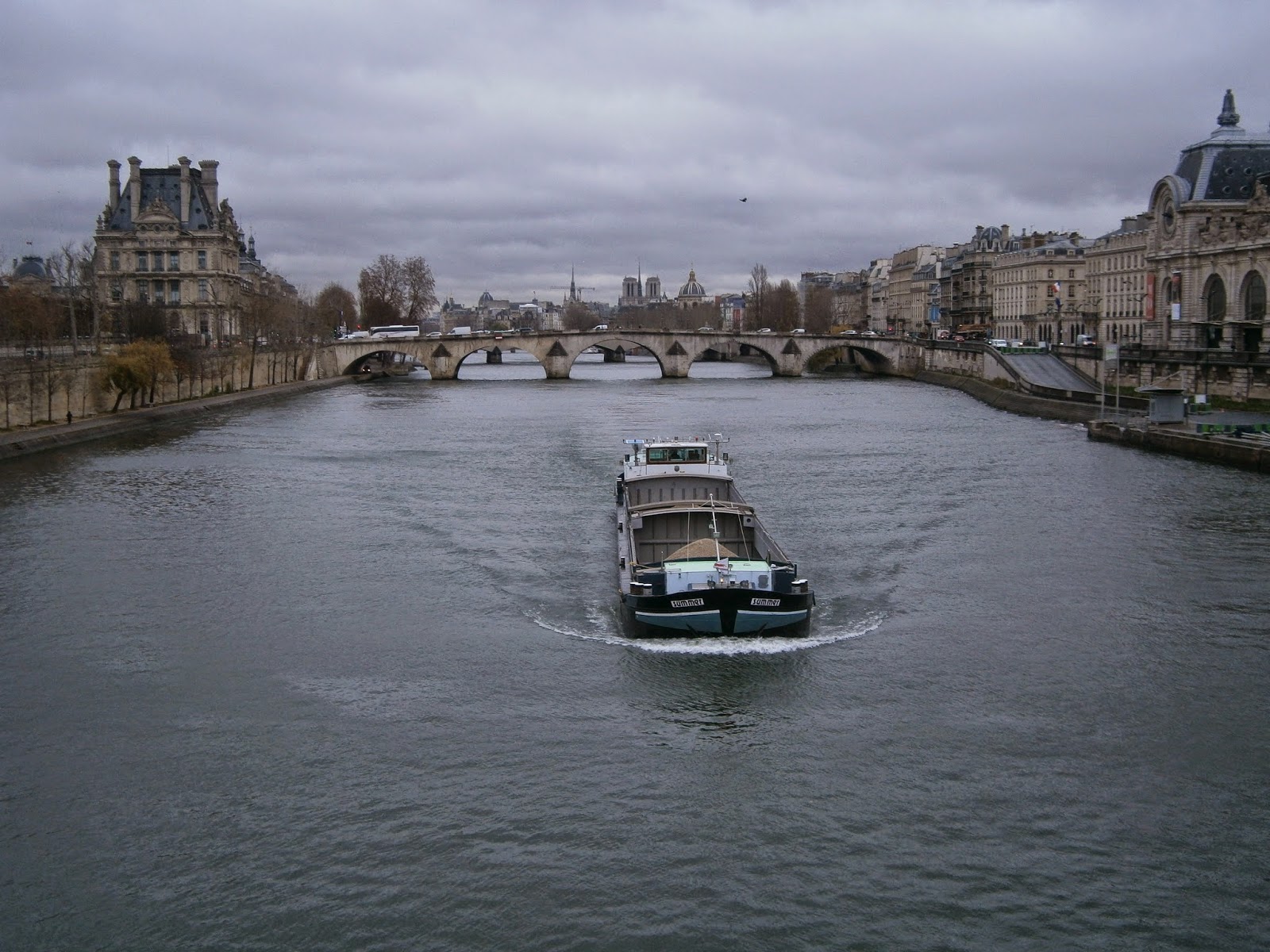
The next evening we enjoyed a boat ride up and down the Seine, seeing Notre Dame, the Eiffel Tower, and what there was to see of the left and right bank of Paris lit up at night.  It was freezing cold and very beautiful.  My photos all turned out to be rubbish.  Taking decent night photos from a moving vehicle can be my challenge for 2015.

One day Brigitte took us to a neighborhood open-air food market not far from our hotel, followed by a charcuterie lunch at a nearby wine bar.  The cheese and sausage and the wine were all excellent, but what I enjoyed the most was the informal, cozy environment that surrounded us in that bar full of regulars – something we (or at least I) would probably not have experienced on our own.  To get to the toilet in this cozy neighborhood joint you exited to the small courtyard at the back and found the door to a tiny room.  The good thing was that the door could be locked.  The toilet, so to speak, consisted of a hole in the ground with small platforms where you were to put your feet.  Having experienced one of these a few years ago in a bar near Avignon, I knew to step back before I pulled on the chain to flush, and thus I did not get water all over my shoes.  The other good thing was that there WAS toilet paper.  This was our second adventure.

At the market


We explored the Sainte-Chapelle and Notre Dame, Latin Quarter, the Marais, the Palais Royal (where Colette used to live), the Musée d’Orsay, Musée de l’Orangerie, and Montmartre. I did the unthinkable and skipped the visit to the Louvre.   I went on my own to revisit the Pere Lachaise Cemetery and paid my respects to Colette, one of my favorite authors.  I meant also to visit Chopin, Edith Piaf, and Oscar Wilde, but they kept hiding from me and it suddenly became late, and it’s a big cemetery, and I didn’t want to risk being locked in at 5:30 and having to spend the night with my idols.   With Elaine (with whom I shared an interest in Art Nouveau and good food) I went to the Musée Decoratif, the Tuileries Gardens, the Champs-Elysées and the Christmas market, and ate at Le Procope and Le Grand Colbert.  I also had lunch with most of the group at the beautiful restaurant in the Musée d’Orsay.

Pere Lachaise Cemetery

This little light of mine...

The Palais Royale where Colette lived for many years


I had one errand to do and took advantage of the fact that you can easily obtain Chanuka candles in France and bought me a box while wandering solo through the streets in the Marais. It was one those small blue boxes that I've known all my life, however, back home when I opened it for the first night, I found that rather than the assorted colors I've always had, these were all white. That wasn't a problem; white candles look nice. Never mind that these dripped like all hell and smelled funny. Then on the eighth night I discovered that the box was one candle short.

Playing football behind the Louvre


Tuesday, December 30, 2014

La Grossa, The Catalan Lottery

La Grossa de Cap d’Any is Catalunya’s New Year’s answer to the Spanish national Christmas lottery El Gordo.  It was dreamed up last year by the Generalitat, Catalunya’s regional government, as one of many measures to try and fix the lousy budget Catalunya receives from Spain.

Catalunya generates 20% of Spain’s economic activity, it contributes 25% of Spain’s tax revenue, and next year it will get back 9% of Spain’s spending (this year it was 11%).  The Generalitat tried to impose a 1-euro per prescription co-pay within its national health care coverage, as well as a tax on bank deposits, and both were struck down by the Spanish government (always trying to find a way to help the Catalans).  So it decided to do a lottery, which turned out to be more popular than taxes anyway.


La Grossa is a cap gross, one of the big heads that, together with giants, are a tradition in the local festivals. 

Artur Mas, President of the Generalitat
with La Grossa

La Grossa does a walkabout

La Grossa by the beach

This year La Grossa was joined by a very special dignitary.  Earlier in the year, Queen Elizabeth II came over to join her in helping to publicize the lottery.  They make a fine pair, don’t you think?  

Her Highness and La Grossa

Her Highness calls La Grossa Mrs. Grossa
La Grossa never utters a word
(and never wears a hat)

But the real question is, will I win this year?  Last year I bought four tickets for me and two as gifts and none of them won anything.  


This year I’ve bought tickets again. 


It’s good to have hope, and the money goes to a good cause – social programs in Catalunya -- where I live.  The lottery will be held tomorrow.  Wish me luck!


All images were taken from internet media sources

Friday, December 5, 2014

United Together or United Apart?

Last week Artur Mas, President of the Generalitat of Catalunya, gave a speech in which he laid out his plan for holding a referendum that would be early Parliamentary elections in the form of a plebiscite since Spain will not allow a legal referendum, and if the vote favored independence, what that parliament would do to set up and declare the new state and how long it would take them to do it. 

He proposed that those in favor of independence would run on a single list of candidates on the pro-independence ticket.  In that way, there could be no misinterpretation of the results of the election.  This would be important, if independence wins, in the resulting negotiations with Madrid, the EU, and in gaining international recognition for the new state when independence was declared. 

In addition to politicians from various political parties, that list would include a number of professionals who would lend their expertise to the setting up of the new state.  This parliament would set up all the mechanisms of a new state within 18 months at which time new, normal parliamentary elections would be held.  Mas would not run in those subsequent elections and neither would the professionals nor a majority of the politicians who had served in this interim period.

President Mas said his proposal called for generosity.  It meant putting individual and party aspirations aside to work together for the single, unifying cause.  He said he would be willing to be first on that ticket or last.  His speech was an inspiration to the leaders of the grassroots organizations that have been organizing the massive demonstrations these last three years, and to the public.

Evidently, it was not an inspiration to Oriol Junqueras, President of Esquerra Republicana Catalana, (ERC, the left-wing Catalan party).  Junqueras is a university history professor who has put aside his academic work to serve for some time in the Catalan government, and he gave his speech this week.  Junqueras proposed that each party run separately but under an umbrella with a common name, such as xx Party for Independence, so it was clear which were the pro-independence parties.  He claimed that this would win more pro-independence votes. 

I think the general reaction to this was dismay.  I saw it on the faces of Carme Forcadell and Muriel Casals, the leaders of the two big grassroots organizations, as they sat in the first row on the audience.  And I could read it subsequently on the posts of my friends and many media commentators.   What people want now is unity – not several parties, each vying for votes, each with its individual platform.

Artur Mas thinks that it is important to show a unified front to Madrid and to the rest of the world (and to the Catalan public!), as has been shown up until now.  That political parties spanning the spectrum from left to center right can sit down and work together as they have done is a great part of the strength of the independence movement.  When President Rajoy came to Barcelona last week, he made a snide comment about the unified list saying it was a ridiculous idea and to please show some respect to the Catalans.  That alone should be enough to get ERC and the alternative left (further left) CUP to join up.

Junqueras had some good ideas.  He said independence should be declared at the start and not the end of the process, thus allowing negotiations to take place between equals and not dominant and subject parties.  And he saw no reason to hold a referendum at the end of the 18 months in order to confirm what had already been voted on in the plebiscite.  Rather, that referendum should be to ratify the newly drawn up constitution.

Some people think Junqueras wants separate lists because that would give him the possibility of being elected president.  I hope that his idea of separate tickets is his bargaining chip so that his other proposals get accepted.  Because Junqueras wants independence probably even more than Mas does, they will probably come to some mutually agreeable resolution to this discrepancy.  Neither one wants to bring the trajectory of the independence movement to a halt.

As one commentator wrote, what is needed is a strong, united political base that will work with vision and strategy, coordination and intelligence.


But my friend Trini said it best: “We have a president who wants to make history and an historian who wants to be president.”

Monday, December 1, 2014

Democracy The Catalan Way

Artur Mas, President of the Generalitat of Catalunya gave a speech last week.  It was a speech that could serve as a lesson in democracy to the Spanish government, to the EU and its member countries, and to the rest of the world.

In his speech, Mas reminded the audience how it is that Catalunya has arrived at its advanced stage of peacefully and democratically seeking independence from Spain. 

There was the Catalan Statute of Autonomy in 2006, approved in Catalunya in a referendum, approved by the Spanish Congress, and later struck down by the Spanish Constitutional Court at the instigation of the PP party.

There was the Financial Pact, approved by the Catalan Parliament in 2012 that President Rajoy would not even sit down to discuss.

Since 2012 there have been three massive public demonstrations for the right to vote on the question of independence.  In the first, 1.5 million people participated, in the second, 1.6 million, and this year 1.8 million.  The Spanish government has chosen to ignore this huge public outcry while President Rajoy and others of the PP party cynically talk about the silent majority.

After refusing to allow a referendum, declaring a non-binding consultation illegal, and finally declaring a very watered-down voting process that would have been simply a citizen participation without official voting rolls also illegal, President Mas held the citizen participation anyway.  Instead of voting rolls, IDs were checked and compared against census information at the time of casting the ballot.

More than two million people came out to vote and over one million eight hundred thousand (80%) voted for independence.  For having organized this citizen participation process, where the public could tell its leaders, on paper, in a countable manner (thus eliminating the question of silent majorities) what it wanted, President Mas, his Vice President, and the Catalan Minister of Education were all three criminally charged by the chief Spanish Prosecutor.

President Mas said that these are not normal times and thus the measures needed are also not normal.  The only way the Catalans will be able to hold a real vote is to have Parliamentary elections in the form of a plebiscite.  This means that instead of running on typical party platforms, the parties state whether or not they support a specific issue – the issue here being independence from Spain.  Parliamentary elections come under the jurisdiction of the Generalitat and there is no way the Spanish government and its courts can stop them being held.

Mas is inclined to hold early elections and made it clear that he will do so only if there is only the one issue to be voted on  – that it not be combined with other possible platform positions.  This way it will be clear to the Spanish government and, equally important, to the rest of the world, what the Catalans were voting for.  With one issue, there will be no question of how to interpret the results.

He also made it clear that he believes it would be best if there was one unified pro-independence ticket – that this would make it clear to the rest of the world that Catalans really were unified in their desire for independence – that they weren’t fragmented by party politics.   The political parties need to put aside their political differences for a short time – an act of generosity -- in order to achieve independence which will only receive international recognition if there is a clear majority of vote.

He went on to suggest, assuming pro-independence won the vote, that this next legislature would last for 18 months.  During that time all the mechanisms of a state would be put in place, negotiations with Spain, with Europe, and with other countries would take place and independence would be declared.

He suggested that in addition to professional politicians, that a number of people from civil society be included in this government that would include leaders of the grassroots movement and experts in useful fields.  

At the end of the 18 months, new elections would be held.  None of the non-politicians would run again for office and neither would a majority of the professional politicians.  President Mas would definitely not run again.  The setting up of the new Catalan state was not to be a tool for political advancement.  Those who participated in the formation of the new state would do it out of generosity.

President Mas is from a center right political party.  Tomorrow we’ll hear what the leader of the Catalan left has to say. 


Sunday, November 16, 2014

One Vote Down, One to Go

It seemed a very long time coming and now, just a week later, it seems that it happened months ago.  I suppose that is because of all the pent up emotions.  Every day we were reading the newspapers and watching the news for the latest development: What obstacle will they put next?  Will the police or army block the entrances to the polling stations?  Will people be arrested?  With all the obstacles and threats, can there be a decent result?  Will it actually happen at all?

Last Sunday, in spite of all that the Spanish government had to throw in their path, 2,236,806 Catalans went to vote on a referendum that if not legal and binding, at least gave them the chance to voice their opinion on paper ballots – a basic democratic right.  That opinion was 80% in favor of independence from Spain. 

Because the Spanish government would not agree to a legal and binding referendum, the Catalan government made plans for a legal but non-binding consultation.  But the Spanish government was determined not to let the Catalans vote under any circumstances, and they filed a complaint with the Spanish Constitutional Court.  The Court, upon agreeing to review the complaint, suspended the consultation and any preparations pertaining to it. 

Artur Mas, the President of the Catalan government, then announced that the vote would go ahead, but not under the Catalan law under which the original consultation had been planned, but as an informal voter participation that would be run by volunteers so as not to put public employees at risk in disobeying the court suspension and it would use facilities owned by the Catalan government so as not to put city hall officials at risk either. 

He put out a call for volunteers, saying that 20,000 would be needed; within two days he had over 40,000.  Several hundred city halls added to the available facilities by donating their own facilities for use that day. 

This meant that going to vote was an act of civil disobedience.  The Spanish government was too circumspect to send in the army (as some wanted), but they had alternative troops: threats, legal intimidation, trying to discredit or eliminate those who are active and important to the movement, and finally, on the day, the attempted sabotage of the computer and phone systems of the Catalan government and the grassroots citizen group that was organizing the event (it is not yet determined who was behind that and will be interesting to find out – but how many people could afford the more than 100,000 euros that the professionally handled sabotage would have cost?  I wonder if it was taxpayers’ money…).

Over 2 million people went to vote on 9 November.  There was a campaign by the grassroots organizing group that showed a famous person holding the photo of an important person, now deceased, but who would have wanted to go to the polls to vote.  The Madrid press made fun of the campaign saying that dead people were going to vote. 

My friend Trini said that she was going to vote for her father, who died about a year ago and who would have wanted to vote Yes.  My Catalan teacher told me she cried as she left the polling station, thinking of her grandfather who had gone into exile after the Civil War.  She was voting for him.  Pep Guardiola, the football coach, flew in from Munich to vote.  People flew in from much farther away too.  They could have found polling stations closer to where they were, there were 14 scattered around the world, but they wanted to come here and be with their friends and family and the rest of their community when they went to the polls.  It was a little like Thanksgiving but without the turkey.  Because they could not use the usual polling places, there were fewer of them and the lines to vote were longer.  But people didn’t mind and there was a good atmosphere. 

The two major political parties in Spain had been against any vote.  The PP party did everything it could to prevent it; the Socialists told their followers not to vote because it was illegal.

The day after the vote the Spanish government began their cynical campaign of belittling the results – of belittling the Catalan people and what, against all odds, they had just achieved.  This was not a referendum, not even a consultation – it was a joke. It was not democratic.   It did not have all the required legal guarantees; not many people went to vote; if more had gone the No vote would have been bigger – would have been the majority, etc. 

This was not a referendum because the Spanish government would not agree to one and it did not have all the legal guarantees of a government-run vote because the Spanish government made that illegal by sending it to court.  If they really wanted to know how many would vote Yes and how many No, all they had to do is allow a legal vote, campaign for No, and encourage people to go and vote -- like Britain did with Scotland. 

As exciting and emotional as all this was, the saga is not over yet.  Now we are waiting to see if criminal charges will be brought against Catalan President Mas or anyone else involved with the organization of last week's voting.

President Mas will probably be calling for early Catalan parliamentary elections that will be a plebiscite where either banded together in groups or independently, the political parties will run on a single issue – that of independence – yes or no.  That will be the real vote, in lieu of a referendum, and I hope it happens sooner rather than later.  With all the dancing around and musical chairs going on – which party will team up with which, or will they team up at all? -- the weeks or months leading up to it promise to be yet another emotional challenge.