Showing posts with label Barcelona. Show all posts

Wednesday, June 14, 2023

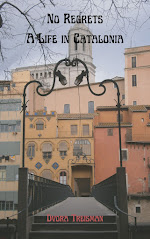
Catalonia Today review of No Regrets: A Life in Catalonia

At the age of fifty-two, I took my cat and flew off from the San Francisco Bay Area to a new life in Barcelona. I had gone salsa dancing, met and married a Catalan, and we were going to live in his hometown.


The adventures began before we even left, with the purchase, sight unseen, of an apartment in the Barri Gotic, and subsequent horrible discovery in a guidebook of what went on in that street. Then there was the shock of the deed arriving in the mail with a different price – a much lower price – than what we had paid.


Once there, things didn’t work out as planned and that set off an even greater adventure than I had bargained for. Things that should be normal weren’t: buying bedding, keeping drunks from peeing under our balcony, buying Chanukah candles in a country where there have been essentially no Jews since 1492.


"Autobiography is a notoriously difficult genre, whose authors often slide into rampant egocentrism or report details that may have mattered very much to them but are of no interest whatsoever to anyone else. Happily, Dvora Treisman has avoided such pitfalls and has produced an entertaining if sometimes melancholy memoir about her life in Catalonia, full of episodes which might appear trivial at first but in fact deftly push the narrative forward so that the reader is, more often then not, left wanting to find out what happens next."  From the review by Matthew Tree, in the June issue of Catalonia Today. You can find the review here.


You can purchase the book on all the Amazon sites, Barnes & Noble, Casa del Llibre, Come In Bookshop in Barcelona, and most brick and mortar bookshops in the U.S. and Britain.

Friday, November 25, 2011

Chanuka Candles in Barcelona

Five hundred and nineteen years after the Expulsion, I went to Barcelona last week to buy Chanuka candles.  In other years (for instance, in year 517 A.E.), I tried, to no avail, to buy them over the internet (too expensive) or place an order to the shop in Barcelona by phone (staff not interested in sending the goods).  Finally, I arrived too late and there were no candles left.  Instead of using my menorah that year, I used a standard taper in a brass candlestick and lit tea candles each evening, adding one each time to the lineup.  Actually, that worked just fine.

If I wanted to be more authentic (and not have to make these shopping trips to Barcelona), I could get eight small jars, pour in some olive oil, place a cotton wick in each, use a larger container for the shamish, and be more true to history.  But my personal history is of small multi-colored candles of yellow, blue, white, pink and red, and the Chanukiah that I inherited from my parents.  Although in fact, my parents preferred to celebrate Christmas.

The year of the tea candles, hearing my woeful tale, my long-lost and recently-found friend Irene was kind enough to send me a box of candles so that the next year I didn’t have to go shopping.  But a box only lasts one year so I was ready for another shopping expedition this year.  And off I went.

There is no searching involved in buying Chanuka candles in Barcelona.  Only one place has them.  So many years after the Expulsion, not many Jews have returned to Spain, and the kosher shop that operates across the street from the main synagogue is the one and only source.

You would never know that this building is a synagogue.  Evidence on the street is discrete, and without knowing the address, you would probably just walk by.  But if you look closely, you can see the entry grill lined with menorahs and finished off with a Star of David on each side at the top (click on the image to enlarge it). 

In order to buy my candles, I take the train to Barcelona – a two-hour ride each way, €12.20 round trip.  From the train station I walk to the shop, about a half-hour walk.  It is possible that I could take some other form of public transportation, but the shop is located a bit out of the way and I haven’t made a study of it.  Anyway, I love walking in Barcelona.  Each time I head off in the right direction, never exactly sure just where to turn, but somehow I always get there with no great mishap, although my route isn’t always exactly the same.

I am very happy to say that this year, I did find candles at the shop.  At €4.50, they were a lot cheaper than what it cost me to get there.  But they’re worth it.

While at the kosher shop I thought I might buy some yahrtzeit candles.  Ever since I ran out of the ones that I brought with me from California, I’ve been using church candles.  This works fine, yet somehow doesn’t seem quite kosher.  But when I went to take some out of the box (seen on the lower shelf), I saw printed on the face of it “Made in China.”  I put them back, thinking to myself, what the hell, that’s not kosher either.

Friday, November 11, 2011

Barcelona with Bonnie

Bonnie's recent visit brought up the usual questions of where to go, what to see, where to eat.  I’ve been a tour guide for friends before, but I think that in the past I was in a better, livelier frame of mind.  I was also feeling more positive about Barcelona and Catalunya.  Now, after the divorce and trying unsuccessfully to sell my house, I feel fairly negative, low energy, and trapped.

But I love Bonnie dearly – she’s been a very good friend to me over the years and I did my best to show her and Forrest what I thought would interest them, even though it seemed at times that I was leading them around in circles.  Well, in fact, at times I was leading them around in circles.

Two blocks up from their Passeig de Gracia apartment was Antoni Gaudí’s Casa Milà, also called La Pedrera.  This is a unique apartment block, all sinuous art nouveau curves and other-wordly shapes.  One of the apartments is furnished for the period and open for viewing and there is also a museum explaining Gaudí’s work in the attic.  The roofscape resembles something from Star Wars.  We didn’t go in because the line wrapped around the block, but it would have been worth seeing.

Although we didn’t visit La Pedrera, Bonnie and Forrest did go on their own one day to see La Sagrada Familia, the large unfinished Gaudí church recently consecrated as a basilica by the Pope.  Bonnie said she thought, judging from the overly decorative façade that she wouldn’t like it, but she found it wonderful inside.  Gaudí was a genius who followed no one’s style, although the sinuous lines of art nouveau (modernism in Catalunya) are evident in his work.  Both the Sagrada Familia and La Pedrera contain museums where some of his innovations are demonstrated and his work is explained.

Bonnie and Forrest also went on their own to visit the Museum Nacional d’Art de Catalunya (MNAC) on Montjuïc (Jewish mountain).  The MNAC houses one of the most important collections of Romanesque art in the world.  In the early 20th century, many murals were removed from the small, decaying 10th-12th century churches scattered throughout the Pyrenees and brought to Barcelona for safekeeping.  The exhibit has recently been redesigned.  I haven’t seen the new installations, but Bonnie said it was fantastic, with many interactive components.  They spent half a day in that exhibit alone.

Mostly we wandered up and down the small streets of the Barri Gòtic and the Born.  That’s my part of town, where I used to live, and the part I know and like best.  We had wonderful fruit juice smoothies at the Boqueria market.  Many stands have these fruit drinks; there wasn’t a single one when I first moved here.  They are obviously provided with tourists in mind, but that doesn’t make them any less yummy.  The problem, however, is that there are so many tourists in the market, that you can hardly walk down the aisles.  And to think I used to do most of my shopping there just eight years ago when it functioned primarily as a market and barely as a tourist attraction.

We passed through the lovely arcaded and slightly seedy Placa Reial which figures in the story told in The Shadow of the Wind by Carlos Ruiz Zafron.  That’s a good thriller along the lines of Da Vinci Code but set in Barcelona and much better written, in my opinion.

From the Placa Reial we squeezed through the very narrow street under the balcony of my old apartment where luckily there was no odor of urine that day.  I have fond memories of the apartment and the music I would hear coming from the street musicians who played in the Placa Reial.  The drunks who would pee on the wall as they passed below seem more colorful now than they did at the time.  Interestingly enough, some of them would whistle or sing opera arias as they passed.

We visited Casa Gispert, one of the older culinary establishments in the city located on a small street just alongside the impressive Gothic church of Santa Maria del Mar.  Founded in the 1850s, they continue to sell the nuts and coffee they roast on the premises in the original wood-burning stove.  Entering provides a very pleasant experience of traveling back in time.

We had a disappointing lunch at Agut, what used to be my favorite restaurant.  The food was so-so and the service came with an attitude, although to be fair, my fideua was excellent.  But on our second day we had a wonderful meal at Orio, a new, elegant Basque tapas bar/restaurant on Carrer Ferran that I had never eaten at before.  We stopped to look at the menu because the fresh oysters in the window had called to me.  But we didn’t order oysters. 

We ordered three starters and one main plate and shared it all, washed down with Basque cider and Basque white wine.  The starters were acorn-fed ham with pa amb tomaquet (bread with tomato), an assortment of four Basque cheeses, and a salad.  The main plate was red beans with blood sausage.  We had ice cream and fried milk for dessert.  Everything was excellent, although the fried milk was a bit weird.  The service was good, with our waiter explaining why it is that they pour both the cider and the white wine from a considerable height.  I assumed it was for theatrical effect, but our waiter assured us that it was for aeration, to cut the acid.  It worked for us.  We were three happy campers with aerated alcohol in our veins and well filled tummies.

After the tasty Basque lunch we visited Gaudí’s Parc Güell, up on the hill (what Catalans call a mountain) behind Barcelona.  The bus ride was an adventure in itself; starts and stops, curves and turns all being experiences to endure.  I don’t know how the driver passed the professional driving test.  Once there, another adventure unfolded. 

There were thousands of people everywhere.  What for me has always been a place of peace and quiet and magic, was more like midtown Manhattan but with unusual rock constructions instead of concrete.  Originally planned as a garden city with scattered villas, only one or two houses were ever built and the grounds now serve as a park.  It’s a unique park and one of my favorite places in Barcelona, or used to be.  The columns and arcades built from natural rocks have always given me the sense of entering into one of the fairy tales my mom used to read to me as a child.  I vaguely remember images of toadstools which have somehow evolved in my imagination to be the rock columns of Gaudí’s arcades.

Besides that good lunch, the highlight of our second day together – at least for me – was watching people dance sardanes in front of the cathedral.  Although it isn’t part of my background or culture, for about two years I used to go every Sunday to dance at the cathedral with a group of Catalan friends.  So for me it was nostalgic to watch people dance and to listen to the music, which, as strange as it may sound to some, sounds wonderful to me.  Unfortunately I didn’t see any of the friends I used to dance with, but I didn’t really expect to.  When the couple who was the driving force of the group broke up, around the time that Manel and I moved to Tarragona, the group drifted apart.  Bonnie said she liked the fact that people were dancing right out in the street.  I’ll bet if she had stayed longer, Bonnie would have started dancing sardanes in the street too.

When we set out the first day, the only thing Bonnie knew she wanted to do during her visit was eat a paella.  She never did.  But then, surely that means, just as the legend that says that if you drink from the Font de Canaletes on La Rambla, she’ll return to Barcelona someday.

Friday, November 4, 2011

Bonnie and Hotels vs. Apartments

It was January 1995 when Bonnie suggested I go ballroom dancing.  That was soon after my divorce and I was feeling down.  Dancing would be good, she told me.  It involves exercise, music, socializing, and, if nothing else, gets you out of the house.  In those days, I called her twinkle toes.  So I went and because of Bonnie I met Manuel and from there a lot of things changed and new vistas opened up.  But that’s another story.

I’ve known Bonnie since about 1972 when our two husbands worked together at the university, and last week I had the rare pleasure of spending time with her.  She was traveling in Europe for the first time in many years, toes now encased in sensible shoes, seeing parts of France and finishing in Barcelona so she could give me a hug

Bonnie used to come to Europe every year but it has been many years since she’s made the trip.  She was here with her friend Forrest who was visiting Europe for the first time.  Before coming to Barcelona they had been in Paris, to Normandy, and along the Loire.

Rather than staying exclusively in hotels, on this trip they rented two tourist apartments.  They were very pleased with their Paris apartment experience.  The apartment was operated by the owner who provided good service and well-thought-out conveniences.  In addition to the well-equipped kitchen, they also had a clothes washer and dryer, and an iron and ironing board.  They could comfortably have breakfast at home before venturing out and in fact, they could buy local ingredients and cook if they wanted.  But they didn’t.  After all, they were in Paris and part of the fun is eating out.  Still, it is convenient to be able to keep food at home and eat in if you feel like it and many hotels forbid any food in the rooms.  The apartment was well situated and the owner was friendly and helpful.

In Barcelona they also rented an apartment.  But unlike in Paris, this one was operated by a large rental firm.  When they booked, they were told the approximate location but not the exact address.  Upon arrival in Barcelona, rather than go directly to the apartment as they had in Paris, they had to go first to the agency’s office.  There, after waiting some considerable time in line, they were given the keys and the address.  They had taken a taxi into the city from the airport but now had to venture out again with their luggage to find the apartment. 

Unfortunately, finding the apartment and then getting into it wasn’t as easy as it should have been.  First of all, the rental firm had given them the name of the street in Spanish (Paseo de Gracia) whereas it, as most streets, goes by its original Catalan name, Passeig de Gracia.  There is no reason why someone who isn’t familiar with the city would know these two are the same street.  All the street signs in Barcelona are in Catalan as are the local maps.  How it is that the company would ignore that and use the Spanish name is hard to say.  But after some initial confusion, they figured it out.

When they got to the building, it turned out that they had been given the wrong key.  Luckily the building had the old-fashioned arrangement of a concierge and he was kind enough to help them out.  Otherwise it would have meant a trip back to the rental office, hauling their luggage (two suitcases each), to get the problem resolved.  The first stop at that office, en route to the apartment, had already added considerable time to their arrival and they were worn out.

This apartment was in a wonderful location, right on Passeig de Gracia, facing the Casa Batlló and Casa Amatller and just down the street from Gaudí’s more famous Casa Milà (La Pedrera).  But in addition to there being no one there to welcome them or tell them about the apartment or the neighborhood, there was also no written orientation material.  There was nothing to explain how to dispose of garbage, no tourist information, no information about where a grocery store might be found nearby, nothing but the user’s manuals for appliances and electronic equipment, and that was all in Spanish.  And oddly, there was an iron, but no ironing board.

So what are the advantages of tourist apartments?  Apartments have kitchens, allowing you to eat in as much (or little) as you choose.  Apartments have normal living rooms with sofas and more space than normal hotel rooms, even the generous ones.  Apartments give you the sense that you are actually living in the city that you are visiting and allow you to be more comfortable when you are at home.

What apartments do not have is a hotel concierge who can help you with problems and difficulties.  What would you do if the hot water stopped running or the electricity went out?  And apartments, unlike hotels, do not have someone on the premises who can help you with tourist questions.  Then there is the check-in, check-out procedure to pay attention to.  If you have an early morning plane to catch, checking out in an agency office might present a problem.

With tourist apartments and villas, there is no set way of paying deposits and rental fees.  Every private rental will ask for a deposit to make the booking and usually (but not always) the deposit is not refundable.  I have seen that many British owners who have villas for rent in my area want the full rental payment weeks before the tenant arrives at the villa.  Many others accept payment upon arrival.

When I rent out my villa I do it this way.  I send a signed contract to the tenant.  When the tenant signs and sends the contract back and pays a 25% non-refundable deposit (by bank transfer), the booking is confirmed.  The contract details what is included in the rental as well as the address of the property.  The remainder can also be paid in advance by transfer or upon arrival in cash.  Some owners accept PayPal or even credit cards, but I don’t.

Renting an apartment is sometimes less expensive than a hotel, especially if you consider the possibility of eating in.  It can be a good way to get more into the feel of a place, and renting a larger one, perhaps with two or more bedrooms, allows you to spend your more relaxed moments in the company of your friends or family if you are traveling with others.  And in that case, it will certainly make your stay much more affordable.

Friday, July 22, 2011

Chaos in the News

Being an orderly person, I always put things away, and I hate clutter.  Disorder and chaos make me nervous.  I want to understand things and there is no way to get a handle on chaos.  For that reason, living in Spain can sometimes be a challenge.

Spain once had a political party of anarchists.  Why would anyone want anarchy? It’s bad enough at home, but on a national level?  The anarchists have disappeared -- I never hear of them – but anarchy and chaos are present.  Building codes are chaotic – either totally unsupervised and ignored or draconian with no recourse to gain exceptions; all sorts of reasonable and useful laws and regulations are not enforced; trains don’t run on time; even the TV news program doesn’t necessarily start on time.  Natives shrug their shoulders a lot.  I have tried to do the same, but it’s given me a stiff neck which paracetamol doesn’t alleviate.

To illustrate, two recent news stories come to mind.

The first has to do with a team of Romanian gypsy women who are roaming the streets of Barcelona, supposedly soliciting signatures on a petition and donations for a charitable enterprise.  I saw these same women, or others just like them, several years ago when I lived in Tarragona, so surely this was not anything new, nevertheless it was on the midday news this week.

In fact, there is no charitable enterprise and they are not so much looking to con you as they are waiting for you to dig into your purse or pocket so that they can steal your wallet, camera, or mobile phone.

That these women do this is not what I found notable.  That they’ve been arrested more than a hundred times and yet are still roaming the streets doing exactly the same thing is.

The other story is about bands of pickpockets who operate mostly on the trains and metro, although they are also on the streets.  They come from Spain, Romania, and all over.  There are so many of them that they are not identified on the news as to their country of origin.  They are far more numerous and multinational than the gypsy women tricksters. 

These pickpockets have been arrested hundreds of times.  They go into the police station and back out on the same day, usually within an hour or two.  It’s a revolving door that could make a person sensitive to spinning dizzy.  They know the police and the police know them, but the police can’t charge them and send them for trial because one must be found with more than 400 euros of stolen property or it is not a crime, nor a misdemeanor, nor anything but a nuisance, especially for the police.  It must be frustrating arresting the same people day after day, week after week, month after month… and have nothing come of it.  If I am peeved by the stories, how must the police feel?

The fact that these pickpockets rob people continuously (mostly tourists in the summer, but everyone is fair game, including the easy target of little old ladies who are out to get their groceries), and that they are never charged was the subject of yet another news story some time back.  In fact, it has been the subject of several news stories over the years, reminiscent of those news stories about the same streets and houses that flood every year when it rains.  If you put the two stories together (the robberies and the revolving police door), you can get a sense of why I find it chaotic here.  Does it make any sense that stealing is illegal but stealing less than 400 euros carries no legal consequence?  Has it occurred to anyone that maybe they should make it illegal to steal, any amount?  After all, 50 euros is a lot to a person who is living on a widow’s pension of 300 euros per month and for that matter, ten is too.

On a more pleasant note, the other day I heard, from the balcony of my temporary apartment, a street musician playing French tunes, Russian tunes, and, to cap it off, Chava Nagila.  That was a bit of a surprise.  It reminded me of when I lived in Barcelona and could hear the musicians playing in the Placa Reial, although not many of them played Chava Nagila.  He played the accordion and played it very well.  He’s Romanian too. 


Note: Comments on this or any other post are welcome.  Click "comments" at the end, and leave yours.

Friday, June 24, 2011

Shopping Heaven: Barcelona's La Boqueria

La Boqueria, the oldest mercat in the city, is one of Barcelona’s gems and one of its greatest tourist attractions.  While a municipal market is about the practical matter of buying food, the Boqueria is an aesthetic and sensual pleasure as well. 

A 19th century iron and glass modernista structure, the Boqueria is located on La Rambla in the heart of the city.  In its early days, it was an open market outside the city walls (which ended at what is now La Rambla), making it easier for the farmers to bring their goods and not have to encounter officials at the city gates nor pay the taxes required to enter the city with their goods.  When the city expanded, the market remained where it was, eventually becoming a central location.  It was porticoed in 1840 and covered in 1865.  It now has 300 stalls and is the biggest mercat in Spain

The food on display throughout the market is laid out beautifully.  When you walk up and down the aisles, the stacks of fruit and vegetables become colorful geometrical abstractions -- patches of pink, yellow, brown, or green.  Bring them into focus and they're pomegranates, lemons, kiwis, and artichokes.   

The tremendous variety of food includes all the summer fruits and vegetables that we're used to in California plus a few I've never seen before.  There are stalls selling meat, others with sausages, or poultry, or cheese, eggs (where you can buy even just one egg if that's how many you want), bread, olives, every imaginable cut of salted cod, and of course fresh fish and seafood which makes up a big part of the Catalan diet.  Unfortunately fish is whole and intact, but they will clean it and even debone it if you ask.  But if you ask to have the heads removed they’ll look at you funny.  Here the smaller fish like sardines and trout are served with heads on.  But if you don’t like that, you should at least save the heads to make a fish broth.


To be honest, some of the displays of meat -- particularly those of hanging dead rabbits or little skinned dead piglets with their heads still on -- are far less appealing than the peaches, oranges, and green beans.  Meat is simply more appetizing when it doesn't look like what it really is.

For the six months each year when Ferran Adria (one of the world’s greatest chefs, who of course buys only the best ingredients) was not making culinary magic at El Bulli on the Costa Brava, he was shopping every morning at the Boqueria to conjure up culinary alchemy at his nearby laboratory on Carrer Portaferrissa in the Barri Gotic.  Shopping every morning is typical here.

Every mercat has one or more bars that serve food and drink.  They tend to buy their supplies fresh from their neighbors who then come to eat what they’ve cooked.  The food is always very fresh and often wonderfully good.

Pinotxo (Pinocchio), a tiny bar just to the right of the main entrance, is one of several bars where you can eat in the Boqueria.  It is owned and run by Joan, a middle-aged man who wears a crisply ironed shirt, a bow tie, and a smile no matter how oppressive the summer heat and humidity.   Joan works with two nephews and two other helpers.  There are five of them working behind the twelve-foot counter with stools for ten in front.  The food is fresh, homemade, and delicious.  If you want to know what they have today, you ask, there being no carte (menu). 

When I lived in Barcelona, the Boqueria was my main place to shop and I visited Pinotxo as often as I could, mainly for morning coffee and pastry – lunch being a bit pricey for my budget.  Once when I came for breakfast and asked for a café amb llet (coffee with milk) and a croissant, they had me wait a minute while someone went to a neighboring bar to buy the croissant for me because they had run out.  This kind of care and service ensures a devoted following. 

The food at Pinoxto is excellent typical Catalan fare and there is even a book about it titled Pinotxo: La Vida i la Cuina.  Unfortunately, it is in Catalan and not available from Amazon.  On the other hand, Colman Andrews’ Catalan Cuisine, the definitive Catalan cookbook is in English and is available.  Andrews gives you suggestions for the best substitutions of American ingredients for any Spanish ones that are not easily available in the U.S. as well as background to the recipes, making this a very useful and readable cookbook that allows you to conjure up your own Catalan dishes, wherever you happen to be, and even if you couldn’t buy the ingredients at the Boqueria. 

Sunday, June 13, 2010

Visitors

In the last few weeks I’ve had a very lively time with three great sets of visitors, starting with Bill and his wife Anita, who came in mid-June accompanied by friends of theirs. I’ve known Bill since 1977 when he entered the undergraduate program to study photography and I was working at UC Berkeley’s College of Environmental Design. He and I had Los Angeles in common, and over the years we would sometimes drive down to L.A. together to visit our respective friends and families, poor six-foot tall Bill with a delicate back scrunched into my low-flying Volvo P1800.


Many years ago when Anita still lived in Germany, she was planning a trip with another couple and advertised in the local paper for a traveling companion. Dorith, recently divorced and wanting to travel was putting an ad in the same paper but missed the deadline. Later, when Dorith was reading through a copy, she found her own ad, only it had been placed by someone else. The two of them have been traveling companions and good friends ever since.

We started out with the great city market La Boqueria where the fruits and veggies are set out like works of art; then we made our way through the Barri Gotic, the old part of town where I used to live. Anita had read The Shadow of the Wind, so she was very pleased to be able to visit two locations mentioned in the book: the lovely Plaça Reial where the ethereal (and blind) Clara Barceló lived in a beautiful 19th century apartment, and the Plaça de Sant Felip Neri where the character, whose name I have forgotten, the woman who worked for Julian’s publisher used to live. The Plaça de Sant Felip Neri is a romantic, tiny square, and one of my favorite spots in the city. It sits over what was once a medieval cemetery, but more notable are the walls of the Església Sant Neri, marred by countless chips from where the bullets of firing squads struck when Franco troops executed people during the Spanish Civil War.

I had booked a table at one of my favorite Barcelona restaurants, Agut on Carrer Gignas. The German visitors were pleased. Not only did it have a good review in their guidebook, but the name that means “Oh good!” in German was an auspicious sign. Anita had the menu del dia but the rest of us ordered a la carte. I had grilled baby squid with blood sausage sauce that may sound a bit over the top, but was wonderful, the sauce being tasty but mild and not overpowering the squid.

A few days after I saw Bill I went back into Barcelona to see Sue and her mom. I also know Sue from Cal where she also studied photography and in fact, Bill and Sue vaguely know each other. When I knew Sue at Cal she was making a name for herself as a rodeo photographer. One of the pictures I have of hers is a shot of three cowboys, sitting on a bench, waiting their turn to compete while laughing and having a good time. It is a wonderful image of camaraderie that I have always kept on the wall of my dining room.

Sue’s mom is in her 70s and is in the process of taking a cruise with each one of her three daughters. The first was a river cruise down the Elbe River from Berlin to Prague; later she will sail through the Panama Canal. Her cruise with Sue started from Barcelona, going down the Spanish coast to Gibraltar and then up the other side to Rouen, stopping at Valencia, Cadiz, Lisbon, Oporto, La Coruña, Bilbao, Bordeaux, Guernsey. They came a few days early to see Barcelona and especially some of Gaudí’s buildings.

By the time we got out of their hotel it was late, so we set off walking to the old part of town for lunch at an historic artist hangout. The 4 Gats looks like it says the 4 Cats, and oddly enough it does, the Catalan word for cat being gat. This is neat because that way, even if you misread the name, you’re still right. Designed by Josep Puig i Caldafalch, a contemporary of Antoni Gaudí, it is a colorful restaurant and bar loaded with tiles on the walls and an old fashioned feel and was where all the artists (including Picasso) hung out in the early 20th century. It is very popular with tourists but I think locals like it too; it’s a good place to enjoy some nostalgia and decent food.

During lunch Mom asked if I knew where there were some Roman columns standing within an office building. She had seen it many years ago and wouldn’t mind another look. It just so happened that I did know, so after lunch we went there. The two thousand-year-old Roman columns, from what was the Temple of Augustus, now sit in an interior courtyard of a building only a few hundred years old, on a tiny, narrow street, off the beaten track. Even as you enter the building entry courtyard, you don’t see the columns; you must go to the back and turn before they come into view. We entered, we turned, we stepped into the inner sanctum, and Sue fell. She was so busy looking up and taking photos that she didn’t see the three stairs that led down to the bottom of the courtyard. There she was, head near the ground, feet up towards us. Her mom and I started towards her to help her up but Mom didn’t notice that we were standing on a ledge – there was no railing. Next thing, Mom went off the three-foot cliff onto the concrete floor below.

I didn’t know what to do first: help Sue up, get down to the level below to see to her mother, or call an ambulance. A couple of French tourists came to help us and in the end, both the women were all right. Unbelievable. These two women may have difficulty staying on their feet, but they’re tough. After resting for a while, they decided they were not up for the walk back to the hotel, so they climbed into a taxi and set off to collect their luggage and then head for the port and their cruise ship. Sue told me later that her mom took another fall at Gibraltar. She wasn’t seriously hurt there either but she bled a lot and was attended to by the very cute ship’s doctor.

The week after Sue’s visit, Shelley came. I first knew Shelley in Los Angeles when she was probably about 12 and I was 18 and her counselor in a Jewish youth organization. Now, some 45 years later, she is a lovely woman with grown children. She was here with her husband and daughter and another couple with their daughter. The two daughters had been studying in Spain.

We met on Passeig de Gracia and since it wasn’t yet time for lunch but people were hungry, we walked down to the Boqueria where they bought somewhat expensive prepared, cut up fruit and I got a strawberry and coconut juice smoothie. There are many stands now in the Boqueria that cater to tourists and sell this kind of thing, where just a few years ago, when I first moved here, there wasn’t even one. But once you work your way in past the entrance, it is still the same old wonderful market with an impressive variety of fruit, vegetables, fish and seafood, meat, and all manner of edibles all beautifully laid out.

Hunger abated, we walked a little around the Barri Gotic before heading off for lunch. We went to what was once the mikvah (ritual baths), now a back room in an upscale furniture and tchotchkes store, and then to where the main Jewish synagogue of Barcelona once was. This is the area that was the ghetto before the Jews were thrown out. There is something sad in that; you get a feeling of something lost. And the fact is that where I used to live was also in the ghetto, although it took a while before I found that out; the original ghetto ended at a street about two blocks away. But at some point the ghetto was enlarged and our apartment was within that area. My mother used to say that she thought she descended from Spanish Jews. But as far as I know, that was because she looked Spanish rather than because of any information or legend passed down through her family. Still, that area of Barcelona gives me a feeling of connecting with my past, even though it is unlikely that my past took place there.

The Barri Gotic is a wonderful part of the city that gives me the feeling when I walk the streets that I have gone back in time. The streets are very narrow – like alleyways many of them – and some of the stone buildings have settled so that they lean – precariously, you could say -- lending an air of claustrophobia to those walking below. I enjoy being in a place where history is not only in books, but in the streets. People have been living stacked up in these apartment buildings for many hundreds of years. The building where we used to live was about three hundred years old. The entry and stairway looked worn and shabby, but the apartments, with their tall ceilings and French door windows, the beamed ceilings, and the wonderful tiled floors of those apartments that had not been modernized were beautiful. Our apartment had been modernized and we no longer had the pretty old checkerboard floor (that you could see in one tiny space that had been closeted over, and the windows were now aluminum), but the twelve-foot high beamed ceiling remained.

Shelley and the group wanted the option of the best food, so we went for lunch to Agut where I once again ordered those marvelous little calamaris with the blood sausage sauce. Some of the others were a little put off, but when they tasted mine, they agreed that it was wonderful. After an excellent meal we walked back into the Barri Gotic, heading for the Plaça Sant Jaume, and it just so happened that the city hall had all its special rooms open for public viewing, as part of the city celebration of Corpus. I had to keep reassuring my guests that what looked like a museum was a real, functioning city hall. In the entry, the city giants and some of the bestiary was on view because of the holiday where they would be paraded around town as part of the celebration. Later, Shelley and I went into a couple of the medieval courtyards where the Ou com balla, or dancing egg, a Barcelona tradition for Corpus and Christmas, was on display, bouncing on top of a jet stream in ancient fountains decorated with fresh flowers.

Being with Shelley, Joanne, and the rest of her group was comforting – a bit like corresponding with Irene. They all live in Berkeley, my home town (I adopted it) and a place I will always identify with. We seemed to have a lot in common, and we didn’t just talk, we schmoozed. Lots of Yiddish words peppered our day, giving me a very pleasant sensation of familiarity.


Photo credits:
Bill, Anita Carstensen
The Boqueria, Bill Johnson
Cowboys, Sue Rosoff
4 Gats, me
Roman Columns, Sue Rosoff
Shelley and me in the mikvah, Lauren Halperin
Ou Com Balla, me
Kvetch, me!