Showing posts with label Figueres. Show all posts

Wednesday, June 14, 2023

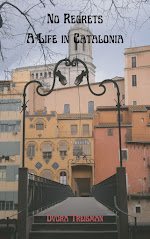
Catalonia Today review of No Regrets: A Life in Catalonia

At the age of fifty-two, I took my cat and flew off from the San Francisco Bay Area to a new life in Barcelona. I had gone salsa dancing, met and married a Catalan, and we were going to live in his hometown.


The adventures began before we even left, with the purchase, sight unseen, of an apartment in the Barri Gotic, and subsequent horrible discovery in a guidebook of what went on in that street. Then there was the shock of the deed arriving in the mail with a different price – a much lower price – than what we had paid.


Once there, things didn’t work out as planned and that set off an even greater adventure than I had bargained for. Things that should be normal weren’t: buying bedding, keeping drunks from peeing under our balcony, buying Chanukah candles in a country where there have been essentially no Jews since 1492.


"Autobiography is a notoriously difficult genre, whose authors often slide into rampant egocentrism or report details that may have mattered very much to them but are of no interest whatsoever to anyone else. Happily, Dvora Treisman has avoided such pitfalls and has produced an entertaining if sometimes melancholy memoir about her life in Catalonia, full of episodes which might appear trivial at first but in fact deftly push the narrative forward so that the reader is, more often then not, left wanting to find out what happens next."  From the review by Matthew Tree, in the June issue of Catalonia Today. You can find the review here.


You can purchase the book on all the Amazon sites, Barnes & Noble, Casa del Llibre, Come In Bookshop in Barcelona, and most brick and mortar bookshops in the U.S. and Britain.

Sunday, September 4, 2016

More Than Just Toys

For anyone who enjoys, toys, antiques and nostalgia, the Museu del Joguet (Toy Museum) in Figueres is the place to go.    Housed in a grand building dating from 1767, the collection is based on the donation of a local collector in 1982.   Since then the collection has grown with donations from many others.  In a way it is a personal museum where you can find among the ancient toys, vintage photos of some of the people whose toys were donated through the years and some who are sitting or playing with their toys.  Even if you live here, you might not be familiar with many of the people in the photos.  But some – including the present and former Presidents of the Catalan government – are familiar to everyone here.

Dolls are often weird.  Toy cars are great.  Miniature stage sets where you could stage your own play are delightful.  Stuffed animals are eternal.  Army and war toys are unfortunate, but a fact of life.  The photos of Catalans, some of them famous, taken when they were children, are priceless. 


A whole display case of caganers 


Not just any bear, this once belonged to
Anna Maria, Salvador Dali's sister
Salvador Dali, age 6
Carles Puigdemont, President of the
Generalitat of Catalunya

Artur Mas, former President of the
Generalitat of Catalunya

Either the father and uncle or grandfather
and great uncle of one of my friends
from the dog park!

There were two photos that were especially moving.  One was of Salvador Puig Antic, a young Catalan anarchist, born in Barcelona, who, in 1974, at age 25, was executed in Barcelona by the Franco regime, having been accused of killing a Guardia Civil.   His photo sits alongside his model train set that his family donated to the museum.


The second photo is of Muriel Casals i Couturier.  In it, at age six, she is sitting and reading Babar.  Muriel was the President of Omnium Cultural, a Catalan cultural organization for several years and became a household name when she became one of the two main driving forces – together with Carme Forcadell -- behind the grassroots Catalan independence movement.  Beloved by many people here, she died tragically in February 2016 after having been struck by a bicycle in Barcelona.  


Friday, August 8, 2014

Figueres During the Spanish Civil War

Figueres was one of the cities most bombed during the Spanish Civil War.  This was especially true near the end of the war, in late 1938 and early 1939, when thousands of Spaniards passed through it on their way out of Spain and into exile.  Added to those on the refugee route, there was the special target of Castell Ferran, a large military fort on the hill above the town (still standing) where the governments of the Spanish Republic and of the Generalitat of Catalunya had set up temporary headquarters.

Spain had thrown out its monarchy, elected a government, and became a republic when General Franco started an uprising.  His allies were Nazi Germany, Fascist Italy, and Fascist Portugal.  Both the Germans and Italians helped with the bombing of Figueres.  But the free world did not rally behind democratically-elected Republican Spain.  France, England, the United States, Canada, all the great western powers were neutral and quiet and even went so far as to ensure that no material aid could reach the legitimate Republican government.  The Spanish Republic did receive some aid from the Soviet Union and from Mexico.  Most notably the Spanish Republic received thousands of private citizens from the United States, France, England, and all over the world who came to volunteer in the International Brigades.


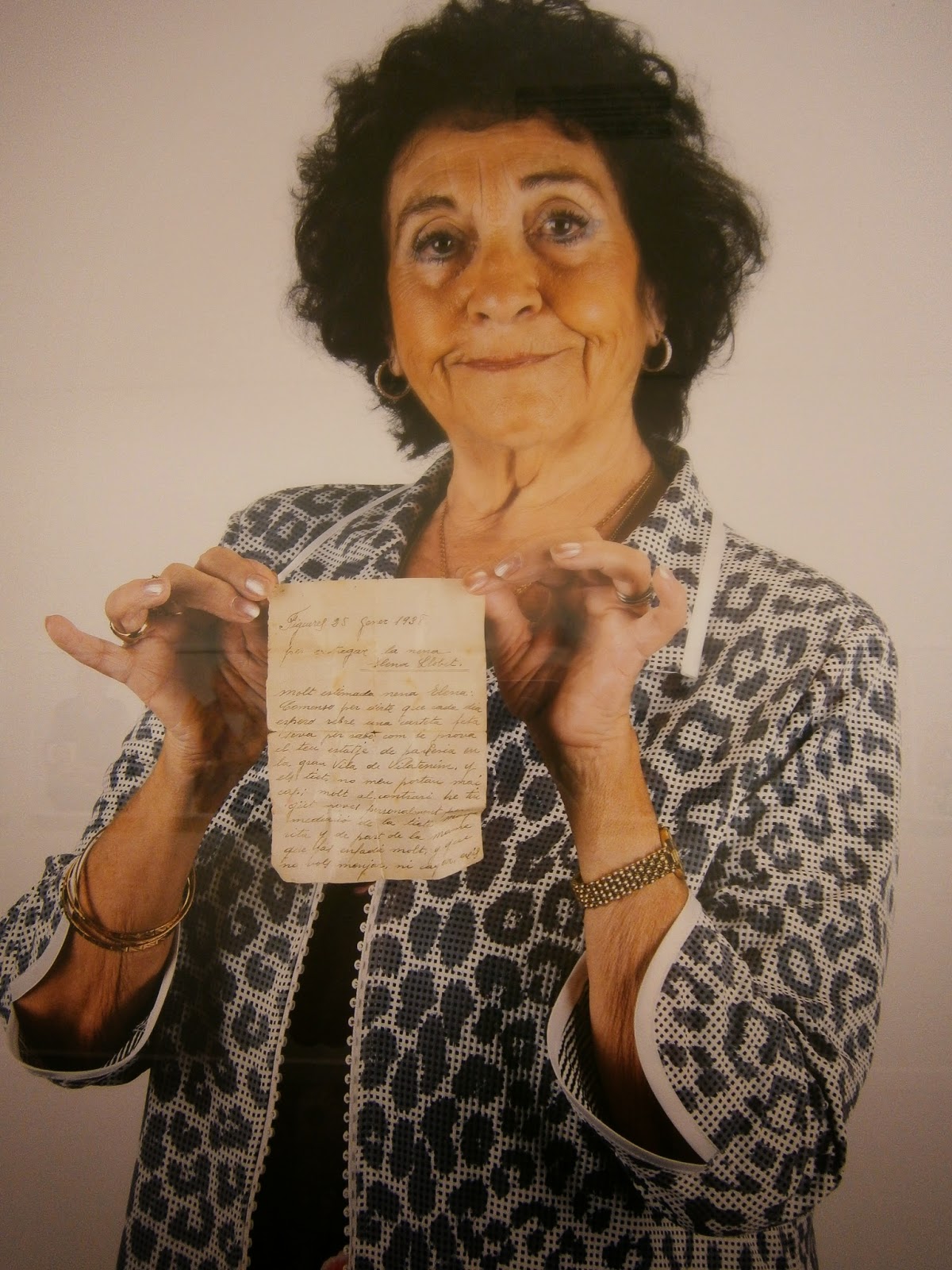
Currently on display in Figueres, in the Museu de l’Empordà is an exhibit entitled “Silencis: Figueres Sota Les Bombes, 1938-1939” (Silences: Figueres Under The Bombs).  It consists of a video, of testimonies, and of photographs of some of the older people who live here now and who lived here then and who were witnesses to the bombing. It is titled Silences because many of them say that their parents never talked about those days.  Nevertheless, they have never forgotten.


"When I returned to Figueres, my spirit fell to my feet.
I didn't know anyone.  It was all soldiers and Arabs.
The streets were dirty; the houses fallen to the ground.
I didn't find my friends.  It affected me a lot."
Franco's allies were Nazis and fascists, but a good deal of his manpower came from Morocco: 136,000 Moroccan fighters fought with Franco's troops, thus the reference above to the Arabs.


"My friend died decapitated.
She was wearing a new dress and her mother told her not to get it dirty.
When the bombs fell, everyone lay on the ground except her."


"When the sirens sounded we went to the entrance,
under the arches of the stairway.  My grandfather never came down.
He said "What the fuck!  If one has to go down, they can
just as well crush me here as below."

This lady is holding the Catalan
and Spanish Republic flags.

Spaniards also died in German camps, mostly at Mauthausen.
They were sent by Franco to his friend Hitler.


Photo credits:  All portraits by Jordi Puig

Friday, July 20, 2012

Ángeles Santos


Now that I live in a town not all my problems are solved.  I still deal with loneliness, even more so now that I don’t know anyone here except my friendly neighbor Ines with whom I’ve gone out a few times, once to a fee concert and twice to sardanes (she to watch and me to watch and to dance a little!).

When I want to I can be friendly and fairly outgoing, so I am hopeful that eventually I will make some friends here.  Part of that is up to me and the rest is a matter of chance or luck.  I must admit, though, that there have been many times when I’ve thought that the lesson I was meant to learn in this life was how to be alone.

What has improved a lot is the possibility of taking advantage of cultural possibilities.  Concerts, dances, fairs, and exhibits are now easily accessible.  So for the first time in many years, on a very hot day this week, when doing almost anything was out of the question, I managed to walk out my door and to the Museu de L’Empordà, the local art museum, just five minutes away.

I never heard of Ángeles Santos Torroella.  She’s a Catalan painter, born in Portbou, a small coastal village near here, who now, at 101 years of age, lives in Madrid.  I wouldn’t say I was crazy about her work, although  I did like some of it, especially the self-portrait used to advertise the exhibition.  It was the process of viewing the paintings, mixed in with photos documenting some parts of her life, that was so very enjoyable.  This was a temporary exhibit.  I’ll be back to see some of the others and their permanent collection soon – one exhibit at a time in order to savour it.