

Showing posts with label Sant Jordi. Show all posts

Sunday, February 26, 2023

Books, Roses, and Lies


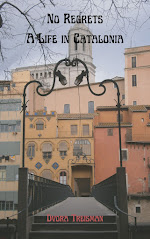
I thought it would be a good idea to promote my book, No Regrets: A Life in Catalonia, by coupling it with the holiday of Sant Jordi. Saint George is the patron saint of Catalonia and his holiday, celebrated on 23 April, is the Day of the Book and the Rose.


It started out as a normal saint day and was celebrated with men giving women a red rose. That symbolized the red rose that grew where the dragon’s blood fell. If you are not fully versed on Catholic saints, it was George, a Roman soldier who was martyred for refusing to denounce his Christian faith and, more important to this story, who slew the dragon and saved the princess.


The idea of books came up hundreds of years later. In the 1920s, a book seller in Barcelona thought it would be a good idea to publicize and take advantage of the fact that both Shakespeare and Cervantes died on the same day – 23 April and thus promote reading and book sales.


This evolved to books becoming part of the Sant Jordi celebration. Now, each year on 23 April, every Catalan city, town, and village hauls out dozens, if not hundreds of stands full of books and roses.


Taking the cue from Catalonia, in 1995, UNESCO declared 23 April World Book Day. This has caught on pretty well in England where George is also the patron saint, and perhaps less so in other places. It seems to me that to promote this holiday in the U.S. would be a good thing, and of course it would be a good thing if any bookshop would highlight my book on that holiday, especially since one of the sections is devoted to explaining Sant Jordi.


In preparing my promotional letter to several Berkeley bookstores, I intended to include a link to the Wikipedia page on World Book Day. But to my horror, when I went to look at it, it cited Lisbon, Portugal as the place where the holiday originated. It said that George was Lisbon’s patron saint, which is not true. None of it was true.


So I contacted my friend Matthew Tree, a British/Catalan journalist (we’ve never actually met but we’ve been in contact for some years) thinking he would know how to correct the entry. I also contacted the Catalan Office of Foreign Affairs and one of the pro-independence political parties. Although Matthew didn’t correct the entry, someone did, he and I were left with suspicions. I had probably consulted that page sometime before. After all, I’ve written about Sant Jordi several times on my blog and in my book, and I know I looked for sources of information. So who would go in and make such a ridiculous change?


Today Matthew’s article in a Catalan newspaper appeared, informing Catalans of the misinformation that had appeared on Wikipedia. In it he says that I had contacted him about it a couple of weeks ago. He points out how in that article the Catalan origin of the UNESCO World Book Day holiday was erased from history. Lisbon has two patron saints, Vicente de Zaragoza and Santo Antonio de Lisboa, but no George. The holiday was never celebrated in Portugal until last year after the Catalan government proposed doing so to the Portuguese. He also says that he knows first hand that in London and many other places, booksellers refer to April 23 as “Saint Jordi’s Day.”


When I saw that article in February, I noticed that the last revision had been done in January. Matthew wonders (as do I), who could have had the time and desire to place that false information on the internet? He recalls a 2010 article by Màrius Serra in which he explained that someone had entered Google Translator only to get “I’m from Catalonia” translated as “I’m from Spain.”


Who? Why? Someone loaded with prejudice, intent on misrepresenting Catalan reality.


To see Matthew’s article in El Punt Avui (in Catalan) click here.


Monday, April 23, 2018

The Day of the Book and the Rose


Today is Sant Jordi, for me, the nicest of the Catalan holidays. Saint George is the patron saint of Catalonia, but his popularity spreads far and wide. He is also patron saint of, among others, England, the country of Georgia, Malta, Portugal, Romania, and the boy scouts.

Saint George is the one who slew the dragon and saved the princess. Where the dragon’s blood fell, a red rose grew, and so the tradition in Catalonia is for men to give roses to women. But there is more to it than just roses. Early in the 20th century, it became the custom for women to give a book to men. This was started by a bookstore owner in Barcelona who noticed that Miquel Cervantes and William Shakespeare died on the same day and thought that somehow, that could make for good business. The book thing caught on and 23 April became the day of the book and the rose in Catalonia and has recently become UNESCO’s International Day of the book. Nowadays women give books and/or roses to men and men give books and/or roses to women because Catalonia is a modern and liberal society not totally stuck in gender roles, and because they value literature. Sant Jordi is the Catalan version of St. Valentine’s Day.

Pretty much every town has a plaza or promenade where there are book and flower stalls. Some of these are run by bookshops and florists, some by political parties, some by non-profit organizations. The main event, of course, is in Barcelona along La Rambla where today there are over 900 bookstalls and where they expect over a million people to stroll and buy books and roses. Total book sales for today throughout Catalonia are expected to exceed 1.5 million copies.


Each year we visit the stand of the rescue group
that brought me Cupcake

This year the holiday felt a little different.  You couldn't help but remember that the two Jordis, the two grassroots leaders, were both in jail. thrown there without a trial and denied bail.  Since the Spanish government has taken over the Catalan government, there will not be the usual institutional events such as the blessing of the roses at the government palace or the speech of the Catalan President since there is none.  Nevertheless, the illegally deposed president did issue a short video, not from the government palace but from Berlin where he is in exile.  He sent greetings for the holiday that were broadcast on Catalan news and on Facebook. This is not a Spanish holiday; it is celebrated only in Catalonia.

School kids listening to a story being read

The Rambla of Figueres


Tuesday, April 25, 2017

Sant Jordi

Every year on 23 April, Catalonia celebrates the festival of Sant Jordi. Sant Jordi (Saint George) is the patron saint of many places, including England and Catalonia. George is the one who slew the dragon.  Here in Catalonia his feast day is celebrated as the Day of the Book and the Rose.
The rose represents the blood of the dragon that Sant Jordi slew. Where his blood fell, a red rose grew.
The business about the book is more recent. In the early 20th century, a Barcelona bookseller introduced the idea of the day of the book because Miguel de Cervantes died on 22 April 1616 and William Shakespeare died one day later on 23 April 1616 (which also happened to be his birthday). The idea of the book caught on and the festival has evolved to be one of the nicest holidays of the year.
This is the Catalan version of Valentine's Day in that it is friends and lovers who exchange these gifts -- traditionally, a book for the man and a rose for the woman. But the holiday isn’t just for lovers – the whole family is included and there are almost as many books for children for sale as there are for adults.
The Rambla in Figueres

Les Rambles in Barcelona
photo by Manolo Garcia


In every city, town, and village there is a street or square devoted to the selling of books and roses. In Barcelona you'll find the biggest stretch anywhere, all along the Rambles. Figueres also has a Rambla, even if it is much shorter, and that is where our celebration is held. And as always, on Sant Jordi it was packed from one end to the other.  (No Catalan festival is for the claustrophobic.)

Les Rambles in Barcelona
Photo by Pere Virgili

La Rambla in Figueres
The following day, one newspaper showed a photo of an elderly man, sitting by a window giving a red rose to an elderly woman who was in a wheelchair.  This was the husband of more than 50 years paying his daily visit to his wife who has Alzheimer’s and is in a nursing home and doesn’t remember him or the holiday.   
For about a week before the day, my supermarket always prints out a poem, the winner of a contest, with your receipt. This year’s was:
The streets fill with roses.
And you,
and that book,
are waiting for me on any corner.

(By Cristina Company)

Photo by Pere Virgili


Friday, April 26, 2013

Sant Jordi


23 April is the feast day of Sant Jordi, known to English-speakers as Saint George.  Sant Jordi, the one who slew the dragon and saved the princess, is the patron saint of Catalunya.  When Saint George slew the dragon and saved the princess, a red rose grew from where the dragon’s blood spilled.  Thus, since 1456, the day has been celebrated (only in Catalunya; not in the rest of Spain) by men giving red roses to the women they love – wives, mothers, daughters, and friends.   It is the Catalan St. Valentine’s Day.

In 1923 a Barcelona bookseller began a campaign to also celebrate 23 April as the Day of the Book because the deaths of William Shakespeare and Miguel de Cervantes happen to coincide on 23 April 1616 and, I guess, he thought it would help his book business.  His efforts were successful and since then, books have been added to the holiday, and it has become the Day of the Book and the Rose.  It is one of the loveliest holidays here in Catalunya, where book and flower stalls draped in Catalan flags are set out on the main promenade of every city, town, and village. 


In 1995, 23 April was adopted by UNESCO as World Book Day upon petition from Catalunya.  It’s starting to catch on, but not many people around the world know about it yet.  For any book lover out there, if you didn’t see anything about World Book Day this week, this might be a good time to start making suggestions to your local bookseller to celebrate the holiday next year.

There are always more book stalls than there are bookshops in town.  That’s because stalls are also run by community groups, charities, political parties, and municipalities.  I stopped at the table run by the local group of sardana dancers to ask about upcoming events.  They were disdainful.  Their group only dances in competitions.  Evidently they are a closed group as they asked me no questions about my interest in dancing, my level of competence, or anything else.  That is one community group that I won’t be supporting.

(If you’re a regular blog reader and think you’ve got déjà vu, let me reassure you.  I’ve taken some of the above from my post on Sant Jordi of two years ago.)


Kids with Catalan Independence flags

Together we will build a new state.  Come with us.


Monday, April 25, 2011

Sant Jordi & Gustave Courbet

Saturday was a special holiday (and my favorite) here in Catalunya.  23 April is Sant Jordi, known to English-speakers as Saint George.  Sant Jordi is the patron saint of Catalunya (and many other places – I believe he is the most popular of all male saints).  He’s the one who slew the dragon and saved the princess.  Maybe he is the most popular because his story is more appealing than all those poor souls who were tortured and put to death.  In any case, this remarkable feat was said to have taken place in several locations around the Mediterranean – in other words, many people say “it happened here!” -- and Montblanc, a Catalan town inland from Tarragona, is one of them.  When Saint George slew the dragon and saved the princess, a red rose grew from where the dragon’s blood spilled.  Thus, since 1456, the day has been celebrated (only in Catalunya; not in the rest of Spain) much like Valentine’s Day with men giving red roses to the women they love. 

In 1923 a Barcelona bookseller began a campaign to also celebrate 23 April as the Day of the Book because the deaths of William Shakespeare and Miguel de Cervantes happen to coincide on 23 April 1616 and, I guess, he thought it would help his book business.  His efforts were successful and since then, books have been added to the holiday, and it has become the Day of the Book and the Rose.  It is one of the loveliest holidays here in Catalunya, where books and flower stalls draped in Catalan flags are set out on the main promenade of every city, town, and village. 

In 1995, 23 April was adopted by UNESCO as World Book Day upon petition from Catalunya.  Unfortunately, not many people around the world know about it.  But for any book lover out there, this might be a good time to start making suggestions to your local bookseller to celebrate the holiday next year.

Lately my own reading has tended to books (mostly, but not entirely non-fiction) about art and artists.  Perhaps because I don’t want to dwell on not having much love or friendship in my life right now, I’m focusing instead on beauty.  My recently read list includes:
Chagall: Love and Exile, by Jackie Wullshlager
Vincent and Theo Van Gogh: A Dual Biography, by Jan Hulsker
Brunelleschi’s Dome, by Ross King
Still Life with Oysters and Lemon, by Mark Doty
The Letters of Vincent Van Gogh, by Mark Roskill
The Judgment of Paris, by Ross King
and currently the fictional, Lust for Life, by Irving Stone

The Judgment of Paris was about the beginnings of Impressionism and the fight for recognition of the artists who were developing a new way of expressing beauty and the world, breaking out of the restrictive rules of the official Paris art world.  Gustave Courbet was a Realist painter who was a forerunner to the Impressionists in that he abandoned the classical and approved topics for paintings and instead sought his subjects from real life, engaged in pictorial social commentary, while also using a less distinct style of applying paint.  And it just so happens that the National Museum of Art of Catalunya is now holding an exhibition of some of Courbet’s most important paintings, in order to show how he influenced Catalan painters of that time, some of whose works are also on display.  I had to go. 

Going to Barcelona for Sant Jordi, meant I could see the exhibit and enjoy the ambience of that lovely holiday on the same trip.  Two hours each way by train is not a voyage I take lightly, so I wanted to make the most of the journey.

I’m very happy I went, but not all was jolly.  For one thing, there was the delay in getting to Barcelona.  At San Vicenç de Calders, the train took an alternative inland route, passing through the Penedes wine-growing region, and seeming to crawl along at 30 kph, adding more than half an hour to the trip.  As is typical, this change in route was not explained to the passengers.  At the museum, the women at the ticket counter were unpleasant and rude, but perhaps because I commented on it, they let me in for free as a senior, even though I’m not old enough (yet)!  The young man behind the counter at the museum café overcharged me by 2 euros for a slice of carrot cake.  I asked about the price, but didn’t want to argue, even though it was listed on the menu.  Sometimes it is more convenient to enjoy moral indignation than enter into an argument.  Later, the plate of tapas I ordered at a tapas bar for my lunch took 40 minutes to arrive, so that I was sitting there, alone, while all the other couples at the bar had been served, had left, new ones had come, had been served, etc.  When I finally began to worry that I would miss my train home and I asked what had happened to my mushrooms, the plate came at last.  The Rambla had the usual (wonderful) tables full of books and flowers, but the street was so crowded that one could hardly move.  It was festive and colorful but not for those suffering from claustrophobia or the fainthearted.  Luckily, I am neither.

In spite of these setbacks, the good outweighed the irksome.  Although rain had threatened, and indeed the train was rained on en route, the weather in Barcelona was beautiful, sunny with a blue sky punctuated with fluffy clouds.  They have made a shopping mall of one of the Barcelona bull rings.  It opened recently and is already quite an attraction.  I walked past and maybe I’ll go in next time.  The Generalitat had installed the four large columns, representing the four stripes of the Catalan flag that had been removed from the base of Montjuic during the Franco years.  They now enhance the Plaça Espanya and I thought they looked very good back in their old home.  As always on a clear day, the views from the museum at the top of Montjuic were spectacular.   

I was very happy to see some of Courbet’s paintings in person.  Included in the exhibit were, among others, his Self-portrait with Black Dog; Man with a Pipe; The Desperate Man; The Wounded Man; Jo, the Beautiful Irishwoman; and Sleep.  The real paintings are always more interesting to look at than reproductions, especially the small-scale ones on the internet or in books.  I could see why he was considered the master by his peers.  His paintings stood far out from all the others on show.

I was also very happy to once again be able to enjoy the festivity of La Rambla full of books, flowers, Catalan flags, and people enjoying each other and the day.