Saturday, December 27, 2025

A Jewish Christmas Tradition


American Jews go out to eat Chinese for Christmas. According to an article in the Jewish Telegraphic Agency, Jews heading out to Chinese restaurants on Christmas is not a myth. It’s science! It’s been studied. And they proceed to cite various services and agencies that have gathered statistics to prove it, with Szechuan chicken being the most popular dish.

They go on to mention Elena Kagan’s Supreme Court confirmation hearing in 2010 when she was asked by Lindsey Graham where she was on Christmas day and she replied, “Like all Jews, I was probably at a Chinese restaurant.”

American Jews may not celebrate Christmas, but they do, apparently, have a Christmas tradition. Somehow or other, in the mid-20th century, Jews in the Northeast, especially in New York, began to go out to eat Chinese.

Explanations of how Chinese food on Christmas came about all seem a bit wanting. This article says that Chinese food was acceptable because whatever pork or shellfish there may have been was chopped up into such tiny pieces that you couldn’t identify them. I don’t think so.

The explanation that Chinese restaurants were among the few that were open on Christmas is the standard explanation, but then why didn’t they just go to a kosher deli?.

In any case, being a non-religious, non-observant Jew who wants to participate in my people’s traditions, I decided to go eat Chinese on Thursday. I don’t particularly like Chinese food, but it was Christmas.

So I went to the big Chinese buffet, and it turns out that in addition to Szechuan chicken, spring rolls, and sweet and sour pork, they have paella, fideua, sausages, and all manner of Spanish and other food to choose from. The choice was substantial and so was the place, a huge space that sits 300 or more, and surprise, surprise, it was almost full with far more people than I expected. Some were speaking Spanish, but the majority were speaking Arabic and the women were wearing headscarves. Here, where there are no Jews (I am probably the only Jew in the city), it’s the Moroccans who go out to eat Chinese for Christmas. I wonder if they know they have adopted an age-old Jewish tradition.


Sunday, October 19, 2025

Pumpkin

My cat Pumpkin died in Barcelona 22 years ago yesterday. I don’t have his ashes and I didn’t bury them anywhere. I was younger then and stupid and it didn’t occur to me that I could do that. But I still remember him and always mark the day; he is someone I will never forget and I have his photo up on my fridge along with my other little loved ones who have passed away.

All my pets seem to have marked an era. Pumpkin was the involuntary hero who flew with me from the Bay Area to Barcelona on my great adventure when I moved here in 2001. In fact, he flew with me twice because I came once in 1999, then again in 2001. He wasn’t a particularly brave cat but he was capable of enduring what had to be endured. The plane rides weren’t comfortable for either of us, but I did arrange for him to sit with me in the cabin, tucked under my feet, turning me into a pretzel and him into a yowling, unhappy passenger.

Pumpkin came from the Oakland SPCA. How anyone could surrender or abandon such a beautiful cat is beyond me. When he first came home with me to the apartment on Vine Street in Berkeley where I lived at the time, he was a scaredy cat who spent the first few days under the bed.

Pumpkin moved with me from Vine Street to Spruce, later to Bancroft, then to El Cerrito, then San Leandro, then Barcelona. For a scaredy cat, he did pretty well as far as traveling and moving home goes.

Pumpkin died an expat cat in Barcelona on 18 October, 2003. He was about 12 years old and one of the great loves of my life.

Thursday, July 10, 2025

Millionaires and the Melting Pot

I’ve been meaning to post something for a long time, but somehow it hasn’t happened. However, today I got inspired. What is written below wasn’t written by me, I’ve just typed it up from the book I happen to be reading. The book is Letter from New York by Helene Hanff. It is a collection of beautifully written short essays that she wrote monthly, years ago, for the BBC Radio program “Woman’s Hour.” This one, from March 1981, seems particularly apropos today.


March 1981

I wish to enlist your sympathy for the poor millionaires who live on Fifth Avenue, in New York’s most expensive town houses and co-op apartments. With the coming of the warm months, they’re braced for a long succession of parades up Fifth Avenue, Sunday after Sunday.

These parades are ethnic. Take the Pulaski Day and von Steuben Day parades, in honour of European generals who fought in our War of Independence. Pulaski was a Pole, von Steuben was German, so the Pulaski Day parade is organized by Polish New Yorkers, the von Steuben Day parade by German New Yorkers. There are parades on Greek Independence Day, Puerto Rico Day, Salute to Israel Day, Philippine Independence Day, and so forth, including Captive Nations Day for Armenian, Bulgarian, Czech, Hungarian, Lithuanian and Romanian New Yorkers.

All these parades go straight up Fifth Avenue, which means that at 8 a.m. of a spring Sunday the occupants of a town house are wakened by the boom-boom of the drum and the raucous blare of a trumpet, as the first marching band tunes up under their windows. It will be followed by twenty more marching bands and the millionaires will get no peace for the rest of the day.

The millionaires formed Community Action Groups and demanded that the city issue parades permits only for weekdays. But this was fought by Fifth Avenue merchants, since parade crowds impede shoppers and are bad for business. So the millionaires demanded that the city move its Sunday parades to some other Avenue. This, the city could not do. You can’t give one ethnic group the right to march up Fifth Avenue and tell all other groups to march somewhere else.

When a century ago the first ethnic groups held a parade, it had its right to use Fifth Avenue written into the City Charter. That group still holds the city’s biggest and most popular parade, popular even with the millionaires since it’s never on a Sunday. The parade is held on March 17th, and when that falls on a Sunday it’s held on the 18th because the parade is in honour of St Patrick’s Day, with a reviewing stand in front of St Patrick’s Cathedral.

St Patrick’s Day is unique in New York; for some reasons known to nobody, on March 17th the entire city becomes Irish. But I have to tell you about the one never-to-be-forgotten St Patrick’s Day, back in the Sixties.

New York has always had a large Irish Catholic population and a small Irish Protestant population. But one year in the Sixties the Mayor of Dublin, Robert Briscoe, was to be guest of honour at the St Patrick’s Day parade and the newspapers announced that Robert Briscoe was not an Irish Catholic, nor yet an Irish Protestant, but – Heaven bless us – an Irish Jew. I mean to tell you, the Jewish population of New York went completely out of its mind.

Cohen’s clothing store and Goldberg’s Meat Market painted green O-aposrophes on their signs and became O’Cohen’s and O’Goldberg’s for the day. Delicatessens sold green bagels, kosher restaurants served green matzoh-balls and green noodles in their soup. Whole Hebrew schools turned out for that parade as the annual sea of green floats, marching bands, and schoolgirls in green shorts rolled past the Cathedral, before the three dignitaries on the reviewing stand: Jewish Mayor Briscoe of Dublin and Protestant Mayor Lindsay of New York, with the Catholic Cardinal between them.

Well, this year’s St Patrick’s Day parade has just come and gone and the long Sunday parade season looms ahead. Which brings us back to the millionaires. Why do they put up with it? Why don’t they move?

They’ll keep fighting to have the parades moved to some other day or some other Avenue. But they know that those ethnic parades, which would be unimaginable in any other great city in the world, are the essence of this one, the visible signs of that melting pot out of which New York was created. They know it, because millionaires, too, are descended from poor immigrants, beckoned here by the Statue in the harbour, holding out hope of a better life. So the millionaires and the marchers are all kin – all New Yorkers – like the rest of us.

Friday, April 25, 2025

Books and Roses

The 23rd of April is the feast day of Saint George. George was the knight who slew the dragon and saved the princess; and a red rose grew where the dragon’s blood had fallen. The legend here is that he did that in Montblanc, a small town inland from Barcelona. He is a very popular saint, patron of many places, proclaimed the patron saint of Catalonia in 1456.

I live in Catalonia where the holiday has traditionally been celebrated by a man giving a woman a red rose. But in 1931, this changed. Both Shakespeare and Cervantes died on 23 April and here in Catalonia, that day was adopted as the day of the book, coupled with the Sant Jordi tradition, it became the Day of the Book and the Rose. In 1995, UNESCO adopted 23 April as World Book Day.

 Sant Jordi is by far the nicest holiday in Catalonia. It isn’t a bank holiday, but even when it falls on a work day, like it did this year, everyone spills out to the Rambla of their town to walk up and down, buy roses and books, say hi to friends, and enjoy the atmosphere. This Wednesday there were 2 million books sold in Catalonia (that has a population of 7 million people) and 7 million roses. Men give roses to their lovers and vice versa, people give roses to their parents, siblings, friends, co-workers. I didn’t see that many people walking around carrying books, but almost everyone was carrying one or more roses.

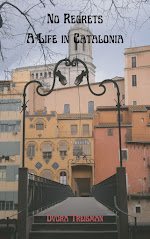
I was there for the books, specifically my own book about Catalonia. Last year was the first time I participated in the festival as an author and bookseller. I liked being on the other side of the table, and I did it again this year, once again sharing a table with my friend Teresa in the section for local authors.


Monday, December 30, 2024

Bluebell

That's Edwin (on the right) who is from the Dominican Republic and Javier (on the left) who is Spanish and speaks English! They are the reception guys at the Citroen garage where I take my C3 for repairs. I’ve dealt with mechanics in Catalan for the past 20 years and each time I learned a new word. But there are a lot of words in car talk and oh my, how much easier it is in English.

My last mechanic, recommended by my friend Josep, didn’t like me. I don’t know why. He was a sourpuss who, when I would come in, would see me, and then without so much as a hello, ignore me for a good long while before asking what I wanted. I put up with him because when it came down to business, he seemed to know what he was doing. But about a year ago, the last time I came, he told me he wouldn’t be able to even take a look at the car for at least two months. I thought I had misheard, but no, “Dos mesos. minim” I took that to mean that he didn’t want to work on my car at all. At Citroen I found Edwin and Javier and was happy I had made the change.

I’ve been without a car now for ten days and it looked like the latest problem was going to be the car’s last – the mechanic couldn’t figure out what was causing it and I won’t drive a car that is incurable. This is Citroen. If they can’t figure out what is wrong with one of their cars, it is unlikely that anyone else can. I don’t use a car much, but there are times when I need to get out of town. I’ve missed two country walks I would have taken during these holidays and it looked like I wasn’t going to be able to go to the beach on New Year’s day, as I had planned. If the mechanic couldn’t figure out what the cause was, I would have to get rid of the car and find another one.

For the last few days I was pondering what kind of used car I was going to look for. But I didn’t want to look for a car. I wanted my car. I like my car. It’s a throwback to the Citroen 2CV – originally the French Everyman’s car, now a classic that I couldn’t afford to buy or maintain. It's the right size, shape, and color. It suits me. So I was a bit worried when I came into reception this morning. But there was no need. After having the car all these days, the mechanic found the problem and fixed it. I have my car back. Bluebell, Sweet Pea and I will be going to the beach on New Year’s after all.

Happy New Year!


Thursday, November 28, 2024

Happy Thanksgiving

Today being Thanksgiving, I took myself out for a special lunch. I’ve always loved the holiday: It’s good to be reminded to be thankful, and of course there’s the food. I love the whole meal but to be honest, if there wasn’t any cranberry sauce, I’d have a hard time eating the turkey. In fact, who needs the turkey? Cranberry sauce, stuffing, sweet potatoes in any form, and pumpkin pie, those are the makings of a happy Thanksgiving for me.

Having no one to celebrate with, I took myself to my favorite restaurant in my favorite place: Restaurant Pont Vell in Besalú. Thanksgiving is an American holiday so you can’t expect the same food here. And in fact, my lunch was completely different: no cranberries, no stuffing, no sweet potatoes, no pumpkin pie, and no turkey. Instead I had fish mousse for first and sausage with mashed potatoes and sauteed wild mushrooms (rovellons) for the main, followed by more mousse, this time chocolate shaped into a cake. And look at the view I had from my table.


They don’t do Thanksgiving here but they have adopted Black Friday with a vengeance. Never mind that it can start on any day of the week, any time in November, and last for days or weeks. Many people don’t know what Friday means anyway. I remember a time when there was no such thing as Black Friday. People started shopping for Christmas right after Thanksgiving, but it didn’t have a name except the Christmas Shopping Season. When did it get a name? Who named it?

Wandering around I saw a truck driver pull off what seemed to me like an impossible manuever, backing into a tiny street alongside a lovely Romanesque chapel. That man should win a prize. And then there was the river and a wee bit of fall in the air. Happy Thanksgiving, everyone!


Monday, November 4, 2024

An Unknown Hero

Varian Fry was a Harvard-educated non-Jew who went to France in 1940 to rescue people in special danger from the Nazis. In less than one year he rescued close to 2,000 people – labor leaders, politicians, writers, artists, Jews. Have you ever heard of him? Most people haven’t.

My interest in Varian Fry was sparked when I first heard about him in And The Show Went On: Cultural Life in Nazi-Occupied Paris by Alan Riding. Such an important hero and yet I had never heard of him. That led me to A Hero of Our Own by Sheila Isenberg, an informative but not very well written biography of Fry. Then I read Fry's own (but abridged) Assignment: Rescue (an abbreviated version for school children of his original Surrender on Demand which is impossible to find for a reasonable price); followed by A Quiet American: The Secret War of Varian Fry, by Andy Marino, a well written biography and the most complete of the books I had read so far.

The people Fry rescued were not all Jewish but they were all hunted for various reasons by the Nazis. They included Marc Chagall, Wanda Landowska, Hannah Arendt, and Andre Breton, among many others. He wasn't trained as and never had worked as a spy or secret agent, but when he arrived in France he found that legal means for getting these people out of France were few, and so he quickly learned what he needed to do.

The best book about Fry is Villa Air Bel by Rosemary Sullivan. This is not a biography, but a history of his work, those who worked with him, and many whom he saved. It is more detailed than any of the others, it is well written, and gives the most complete picture of the rescue work that Fry set up and led. Netflix made a film based on this book, but I didn’t watch it. When I read that they had turned Fry’s character into a gay man, I suppose to add some spice. I decided I didn’t need to. Why add spice to a true story that was so interesting, engaging, and important?

Fry was called back to the U.S. because the State Department did not want him to do his work, and they prevented him from finding any work with the government once he returned. It was very strange instance of the blacklisting of an American hero.

Shortly before Fry’s death, the French government awarded him the “Croix de Chavalier de la Legion d’Honneur,” France’s highest decoration of merit. It was the only official recognition he received in his lifetime.

In 1991, the United States Holocaust Memorial Council awarded the Eisenhower Liberation Medal to Fry. Three years later, Fry became the first American to be honored by Yad Vashem as a “Righteous Among the Nations.”

Friday, October 18, 2024

Cockeyed Optimist


Dolors is an older woman who lives on the next block. We met years ago when we were both trying on shoes at a shop and have been casual friends ever since. We don’t really socialize, but we always stop to chat when we meet on the street. Sometimes I need something and she helps, and sometimes she needs something and I help. But as we get older, helping becomes more difficult.

A few years ago when I still had Cupcake there was a day when I couldn’t take him out. Dolors was a big fan of Cupcake so I called her and asked if she could take him for a walk. She came a few minutes later and I buzzed her in. She huffed and puffed her way up the stairs (there is no elevator in my building). I didn’t know she had a bad heart. That’s the kind of person she is.

Today I met her a few houses down. She now goes with a walker. I had just read in the NY Times that Mitzi Gaynor had died, and reading through some of her credits really got to me: There was No Business Like Show Business (which I never saw but I’ve heard Ethel Merman belt out that song countless times), Les Girls, with Gene Kelly, and my favorite, South Pacific, among others.

I asked Dolors if she knew who Mitzi Gaynor was, but she didn’t. So I told her she had been an actress/dancer/singer in the 50s and she died yesterday. I told her that all these years later, I still sing some of her songs, in fact I sing one from time to time to my dog, and I started to sing A Hundred and One Pounds of Fun... which she knew! She knew the song and now knew the actress I was talking about. Those were the days, she said, her, Gene Kelly, Fred Astaire, those were the days when people did beautiful, graceful, elegant dancing instead of looking like they were having sex on stage. We agreed that elegance isn’t a word you hear often any more. Sexy is what counts. We didn’t sing it, but we both also know another favorite, I’m gonna wash that man right outa my hair.

R.I.P. Cockeyed Optimist

Photo from the NY Times (Getty Images)

Wednesday, August 7, 2024

The Spanish Judicial System vs. President Puigdemont

Not for the first time has Spain made itself ridiculous by searching the Barcelona Zoo to make sure that the former Catalan president doesn't enter the parliament building in a monkey suit or dressed as a lion. The Spanish congress has voted to give Puigdemont amnesty, but Spain's high court feels otherwise and has decided to ignore the law that it doesn't like. So much for separation of powers in Spain as well as the rule of law. Politics in the judicial system (as Americans are learning) is not a good thing. 

You can read more about it here.

Wednesday, July 31, 2024

Sweet Pea the Trooper

Little Sweet Pea, the sweetest, cutest, and funniest little dog, has been injured. It seems to have been an accident. I was with her when it happened, but I didn’t see anything until she started to limp.

This was yesterday when we were on our evening walk (still considered afternoon here, even though it was around seven o’clock). She was bouncing along, as she does, and we were crossing a street where road work has been going on and all of a sudden she started limping. It was her back left leg. I examined her paw but found nothing stuck between the pads so I put her down. But the limping continued and seemed to get worse every second. My vet closes at 8, so, with Sweet Pea in my arms, I high-tailed it over there.

Salomo felt around and told me she had a torn a ligament in her knee. Had she fallen? No. Then she must simply have made a misstep, maybe tripped without my noticing it. It wouldn’t take much. At her age, those joints are brittle. I understand; I know that something similar could happen to me.

This torn ligament is not going to heal. The only way to fix it is with surgery. But Sweetie is an old dog and although she’s practically a whole new old dog from the one I adopted a little over year ago, in her former life she had not been well taken care of.  The recent improvements in her environment have helped, but they haven’t erased her history (whatever that might have been). He legs are all bowed and crooked. The funny way she walks is one of her many endearing characteristics. The vet said initially that she had probably suffered one or more falls and had never been seen to. And her heart is much enlarged, which, together with her age, does not make her a good candidate for major surgery, which this knee operation would be.

Salomo gave her a shot for pain and gave me pain pills to give her for the next twenty days. Let’s see how this develops, he said while also talking about possible future medications. We both noticed that her front leg on the same side was also doing strange things – bowing out at an alarming angle. She’s compensating, he said, trying to keep her balance. Of course that could mean that she will end up injuring that leg too. I should keep her walks to a minimum; just take her out to the street and let her do her thing under the nearest tree out front. I am to carry her up and down the stairs (I live on the 2nd floor, which in the U.S. would be the third floor). There is no elevator

At home I got on the internet and started reading about torn ligaments in the knees of dogs. It didn’t look good. Everyone says it’s very painful. It doesn’t heal, it can only be fixed with surgery. In an older dog, if it happens in one leg, it is likely to also happen to the other because they would both be in the same state of deterioration. Of course that might not happen. Compensating for the discomfort could mean inflicting injury on one of the other legs.

I was plagued with doubt. I don’t want to keep her drugged for the rest of her life, and I don’t want the rest of her life to be painful. She loves to walk and to sniff. If she won’t be able to walk except to go to a tree and pee, what pleasure is she going to have? I got very little sleep.

This morning when the vet clinic opened, I was there with Sweet Pea. I told Salomo I had more to understand. I needed to know what the best possible outcome could be. If it was going to be lifelong pain, I wasn’t sure there was any reason to continue. I don’t believe in just keeping a pet alive if the pet isn’t able to enjoy his life and there is no cure.

But he said no. The tear would never mend, but the pain would subside after three or four weeks so we would reassess her need for medication when the pills run out. He said that Sweet Pea was a real trooper. You could see how in her life she’s managed to successfully deal with all kinds of physical problems. If all goes well, the pain will subside, and she will learn to compensate for the leg that won’t function properly as she did with her legs before.

As for now, she’s eating, she has the desire to go out and once out she wants to walk, even though she can’t and has to stop. At home she gets all excited about going out, like before (although now she doesn’t jump up and down), and she gets excited at meal times. She still likes her treats and she still enjoys a belly rub. She’s still shows signs of being a happy camper. I’ll know when the time comes, he said. She won’t want to eat, she won’t want to walk, maybe she won’t be able to walk, she’ll be lethargic, or we just won’t be able to help her with ongoing pain. That was what happened with Cupcake.

You have no idea how relieved I am. Now it’s just a matter of taking care of her, letting nature take its course and Sweetie’s determination drive the next twenty days, and hope for the best.

I had wanted a senior dog, so when they told me at the shelter that she was at least ten years old that was fine. Two days later, when I took her to the vet and a long list of physical and health problems came to light, I thought, well, that’s okay. Maybe she only has a few weeks left, but she will spend them in comfort with me. I was more or less prepared for a short relationship. But Sweet Pea blossomed during this last year so that now, I am not at all prepared for her to leave. She’s my wonderful companion, she’s funny, she’s sweet, and she’s incredibly stubborn. I hope Salomo is right and my little trooper will get the better of this latest problem and keep on being her cute, sweet self for many more happy years.


Sunday, June 30, 2024

Rooster, Tomatoes, and Death

On our morning walk the other day, I suddenly realized I was hearing a rooster crow. I don’t live in the country; the crowing was coming from an apartment building. Maybe they have a coop on the roof. Suddenly Figueres didn’t feel so grey and urban.

My first Tot Sants (All Souls) here in Figueres, back in November 2012, I did what I usually do on that holiday, I took myself to the cemetery to take photos of all the flowers people were leaving at the tombs of their loved ones. But on that Tot Sants the cemetery turned out to be not as peaceful as cemeteries usually are. When I arrived the police had it cordoned off. There had been a shooting inside and a man had been killed.

It was a drugs-related shooting. The man killed was from France, and the assailant was from Figueres. Later I heard that they had arrested the perpetrator and I thought that would be the end of it, but it wasn’t. This was because both the French man and the Figueres man were gypsies and the aggrieved clan had a score to settle. A few days later the French clan began taking revenge on the clan here in Figueres by killing some of the livestock of an uncle and wrecking some of the homes of other family members. Suddenly Figueres didn’t feel so European.

Last Sunday, on the 23rd, the Eve of Sant Joan – midsummer night – there was a shooting in Girona where four people were shot. They were all taken to the hospital in Girona where two of them later died of their wounds. About 100 members of the clan of the victims showed up at the hospital and were kept at bay by the police.

When I heard the news and heard that the victims were from one clan and the perpetrators from another, I knew they were talking about gypsies. Everyone has families; gypsies have clans.

The victims were shot by a man called Guillermo who was using an AK-47. This is the first time I’ve heard of that kind of weapon being used here. Firearms are much less prevalent than in the U.S. and many attacks are with knives.

Guillermo disappeared immediately. And so did members of his clan who live in Figueres where he was originally from. So when 300 members of the victims’ clan, known as Los Tomates, showed up Friday night to take revenge, their three homes were vacant. The Girona clan had already destroyed Guillermo’s apartment and car in a town near Girona, now 70 of the clan went in and destroyed all three of the homes here. According to gypsy law, those three homes now belong to Los Tomates. While Los Tomates were destroying the properties, the police basically waited and kept people away. They have said that trying to confront three hundred people, many of them wielding axes and bats, would have called for an enormous police presence and would have resulted in escalating the violence. This way, at least no one was injured.

At this point, no one knows where Guillermo or the members of his clan are, and the question remains, who will find Guillermo first? Los Tomates or the police?

When I first came to see apartments in Figueres, I was shown one that bordered on Sant Joan, the gypsy neighborhood. Of course I didn’t know that at the time. Lucky me I didn’t buy it. I remember coming back from a drive a few years ago and following a sign that made my return route different than the one I used to go. All of a sudden I was in Sant Joan where the streets and small plazas were packed with people sitting on benches, chairs they had brought down, chatting, playing guitar, milling around, passing the time. It was nothing like the rest of Figueres where, except for la Rambla, the streets are meant for walking. Suddenly Figueres felt like another world.

Oh, the photo? Yesterday’s brewing storm.

Sunday, June 16, 2024

In Honor of Father's Day

This is my dad the hunk.

This photo was taken in Poland in about 1932 when he would have been 20. As you can see in the photo, my dad was not the typical Eastern European Jew of his time.

You can read all about him (and see more photos) in my book Stories My Father Told Me: From Warsaw, Moscow, Algeria, Siberia, Kazakhstan, Dominican Republic. Yes, he lived in a lot of places, and this is not a complete list.

The paperback and ebook are available at Amazon, paperback is available at Barnes & Noble or your favorite bookstore (by special order). 


Wednesday, May 1, 2024

Stories My Father Told Me


Just Released!

Stories My Father Told Me: From Warsaw, Moscow, Algeria, Siberia, Kazakhstan, Dominican Republic

I wrote this book based on a memoir my father wrote for me late in his life and stories I had heard at the dining table over the years. These are stories from far off places, in far off and very different times. And yet they are of everyday people doing everyday things. They are the stories of my father, Rafał Feliks Buszejkin who was born in Warsaw in 1912.

In his stories he explained what he and the other children did in Russia in the 1910s to entertain themselves in the winter. He never attended cheder, but with a tutor, he memorized his speech for his Bar Mitzvah at the Great Synagogue of Warsaw. In high school there was that band of youths who played poker and got into mischief. He was one of them. He boxed, he worked out and built his muscles, he did track and field, raced bicycles. He failed his last year of high school. He was not a typical Eastern European Jew of that time.

He told stories of wolves in the forest in 1917, and bankruptcy at home in 1933. Stories of university days in France and months spent with Sephardic Jews in a small desert town in Algeria where he set up a Maccabi sports club.

There are love stories, stories of rich men who lose it all and poor ones who become rich. Because he had studied agronomy, he was employed all through the war and all through his life. His war-time stories from Siberia tell of hard work, trying to have enough to eat, and avoiding the NKVD. The Kazakh stories tell of a mix of western and eastern cultures, working for a government agency supervising the agriculture at five kolkhozes, living among the Kazakhs, sharing their food, drink, and yurts, and of spending two months in a Soviet prison for refusing Soviet citizenship.

Postwar brought him from the steppes of Kazakhstan to the French Riviera, then to the Dominican Republic where he farmed in a collective Jewish refugee settlement. And finally, the United States, where there were jobs, the possibility of making a good life, and no secret police.

The book is available as ebook or paperback on Amazon, other online retailers, and your favorite bookshop where you would probably need to order it. If you read it, please let me know what you think. And if you like it, please leave a review on Amazon, Goodreads, or other social media if you can. Thanks!

Saturday, April 27, 2024

Berkeley's Falcons

Annie in 2023
Berkeley has had a pair of peregrine falcons nesting at the top of the campanile in the center of University of California campus for several years. Annie is the matriarch and she started nesting there with her first partner who eventually died. Since then she has had other partners. Since peregrines tend to mate for life, it is believe that the other two also died, possibly of avian flu, but they were not tagged, so no one knows for sure. Annie's new mate is Archie who arrived recently, just in time to start the reproduction cycle, and has been doing a great job of parenting.

The university, via the Cal Falcons group, set up livestream cameras a few years ago. Right now everyone is watching the one pointed at the nest where there are four tiny, fluffy, white chicks. When they get older and start to move around and leave the nest, there will be more activity at the other cameras that are pointed to different ledges. All the cameras run 24/7 and can be found on YouTube or the Cal Falcons website. (Cal Falcons is also on Facebook and Instagram.)

Today, Saturday, we are watching the five-day-old chicks having their breakfast.  At first you see them on their own. (Know that one or both of the parents are nearby. The chicks are never unattended.) Then they start to squeal and a few seconds later one of the adults enters the nest. This is Archie. A few moments later Annie comes with breakfast and Archie leaves. There is no doubt that Annie is queen of the roost and calls the shots.

Click here to see the clip of today’s breakfast. Yum. 

To follow this blog, click here.

Living with a Bitch

Sweet Pea, poor old girl, is in heat. They told me when I adopted her that she hadn't been sterilized but that she was considered too old for the operation. She is now sticking her butt with her tail straight up into the face of any dog that comes along. It's embarrassing! I have to be vigilant that nothing comes of it. One old pooch moved really fast! That was Teresa’s dog, Rubio, a senior she rescued who was once probably a hunting dog and who is now lame. Sweet Pea is in heat and love is in the air.

I wrote that to a friend a few weeks ago in the middle of this upsetting time which, now, thank God, is over. Bitches, it seems, are never too old to have their periods, and in many cases, as in the case with Sweet Pea, each time it lasts for a good four weeks.

The little girl is a sprite with lots of energy. In heat she’s superdog. Or should I say superbitch? I made the mistake of taking her out for one of our country walks so she could get some exercise, and let her off the leash when we were on the path. She was fine on the way out, but when I turned around to go back, she ran ahead and never stopped! I was afraid she would get to the end and run out into the road. She wouldn’t come when I called her, and I couldn’t go fast enough to catch her! But thank goodness, she happened to find a male dog along the way and stopped to stick her butt into his face. If not, I don’t know what would have happened.

I have trouble referring to Sweet Pea as a bitch. I mean, it just doesn’t sound nice. In Catalan it’s nicer. Dog is “gos” and a female dog is “gossa.” A small dog is “gosset” and a small female dog is “gosseta.” It’s all very sweet. When you curse at someone, you don’t call them a female dog, you call them the son of a whore or “cabron,” a goat. A male goat. 

Kings

From 6 January...

Today is El Dia de Reis – the three Kings of the Orient. These were originally considered to be astronomers, mathematicians, or scientists who, guided by a star, came bearing gifts for the baby Jesus. The holiday is preceded the evening before by a parade in just about every city, town, and village, where the Kings ride on floats through the streets, throwing candy to those watching from the sides. In cities, the amount of candy they throw is measured in thousands of kilos.

Traditionally, because it was the Kings who brought presents for the baby Jesus, it was the Kings, rather than Santa who is not traditional here, who brought presents for children. Kids write letters to their favorite king in advance. There are special mail boxes where you can leave the letter, or you can take it to the post office. Usually a couple of days before the parade, the Kings’ pages will set up an encampment in town where children can bring their letters directly. If they are good, on the morning of the 6th they might get what they asked for. If they are naughty, they’ll get a piece of charcoal. Years ago, this was actually a valuable gift for a child in a poor household. Now it is made of spun sugar and dyed black.

The Kings are more colorful, more exotic, and more surprising than Santa. They call them the Kings of the Orient, but Melcior comes from Europe, Gaspar comes from Asia, and Baltasar comes from Africa. Children leave things for the Kings that night, after the parade: water for their camels, and pieces of torrons and cookies and something to drink for the Kings

Sometimes the Kings arrive earlier in the day on the 5th to hold court before the parade. In that case, they will arrive together in various forms of transportation, depending somewhat on the budget of the municipality. In Barcelona and Tarragona, they arrive by boat in the harbor. In Lleida they arrive by train. I remember one year when they arrived somewhere by helicopter. For the parade, they ride on their floats with the assembled entourage which easily numbers in the hundreds, with their pages and countless other floats, bands, and drummers – all local people with the possible exception of a professional comedian or comic troupe -- and they all parade through town throwing confetti and candy. Years ago there would be crews strategically placed between acts to clean up the poop of the camels, horses, or donkeys that were in the parade. But animal welfare groups won the battle to keep live animals out of most of the parades.

When they throw candy to the crowd, there will be those who come with an umbrella and hold it upside down in order to get more than their share. I imagine those are the ones who receive pieces of charcoal for their gift at home the next morning. 


Immaculate Conception

This week is a double-hitter for holidays. Today, the 6th of December is El Dia de la Constitució, a Spanish holiday celebrating the Spanish Constitution. This is a holiday that is not much valued in Catalonia where people feel they get the short end of any Spanish stick, but it is a legal holiday so it has the value of many things being closed and many people getting the day off.

Two days later comes La Immaculada Concepció, also known as La Purissima. I always thought that this celebrated Mary’s immaculate conception of her baby Jesus, never mind that the timing was off, since he was born on the 25th. But when there are so many miracles being celebrated, the miracle of those eight and a half months would have been just one more.

But no, I was wrong, and apparently I am not alone, as there are many Catalans who also don’t know what the holiday is about. La Concepció celebrates the immaculate conception of Mary by her mother Saint Anne. It seems virginal conceptions run in the family. And of course Mary’s virginal conception of Christ takes place on the Feast of the Annunciation, as featured on any number of paintings, on 25 March, nine months before Christmas, the kind of timing you might expect.

So what does it all mean? It means that many people get two days off from work this week, allowing them not necessarily to go to church as they are supposed to, but to go skiing. Two days off in one week means a pont (bridge) which means they add an extra day in between or at the end to tie it to a weekend, and make it into a long weekend. Sadly there is very little snow, but with a five-day weekend, there is still time for a miracle.

Over 400,000 vehicles left Barcelona for the long weekend and what with accidents and breakdowns and so many cars on the road at the same time, many of them got stuck in traffic. Among other traffic jams, those who were headed to France had a long wait at the border near me with 30 kilometers of back up. For some, there are no miracles. 

Wednesday, December 6, 2023

Sweet Pea the Pilgrim


Sweet Pea has come a long way from how she was when I first adopted her in early June. At that time, she didn’t seem to me to be frightened; she didn’t shake or cower, she ate, she pooped, she liked to be petted, she seemed normal. But when you adopt a dog whose history you know nothing about, and one who has just spent a month in a shelter, you don’t really know what normal is.

Normal began to manifest itself after a couple of months. That is when she would meet me at the door when I came in, jumping like a mad person. It was the same when it was time for a walk and I went to change my shoes – something I could hardly do because she was jumping up and down and running all around, and I couldn’t get my laces tied. And all of a sudden she just had a lot more energy. She walked faster and could go farther.

What took longer was to see her begin to enjoy walking out in the fields. One of my greatest pleasures with Cupcake was to go walking out in the fields, or the woods, or at the beach. He enjoyed it as much as I did, if not more. So it was disappointing when Sweet Pea didn’t seem to like it. I had no idea if it was too hot, or if she was afraid, or if she was urban dog who had never been in that kind of environment where there were no buildings or sidewalks, new smells, and she could walk without a leash. Maybe she felt uncomfortable being untethered?

But now, finally, she has joined the doggy walking hall of fame. Today, for the second time, she did the whole circular route – about an hour’s walk, in the fields by Vilabertran. She did it at a good clip, looking like she was collecting data to add to her lift list and enjoying herself.

The path we take around the fields is one short section of the Camino de Santiago. For any pilgrim, the Camino begins at his door. Over the centuries, many routes were established. Now, there are 281 Caminos listed, encompassing more than 51,500 miles of routes through 29 different countries. Forty-nine of them are in Spain, and these cover almost 9,940 miles. One of those connects the Monastery of Santa Maria in Vilabertran with the Sant Pere church in Figueres.

Although I just go out there to enjoy walking with no cars around, breathe the fresh air, and observe the changing crops and Pyrenees Mountains in the distance, I am aware that for many, the Camino is a religious observation and I always feel that when I walk on that path, I am taking part in an historical activity.

In the early Middle Ages, Santiago de Compostela became the third most important pilgrimage destination after Jerusalem and Rome. Making a pilgrimage was one of the most important things you could do to save your immortal soul in those days. By the 13th century 500,000 pilgrims would be walking the Camino each year. Walking the Camino has made a comeback in modern times and whereas in 1985, about 800 people walked enough sections of the Camino to be counted, in 2019 that number jumped to 350,000. They came from 190 countries. In addition to the land routes, there are maritime routes. The longest of these is the Antarctic Route (Camino Antártico) that begins at the Spanish research base, Gabriel de Castilla on Deception Island, 8745 miles from Santiago.

Sweet Pea and I are not being counted. We have not signed up for our Camino Passport and we do not wear scallop shells, although we do see the shell symbol on posted signs that we pass and in the pavement near the monastery. We don’t do the walk for religious reasons and we are not headed for Santiago, but walking out there is good for your soul whether you are religious or not.

1 October


How could it be possible in any democracy that voting would be a crime?

1 October 2023, marked six years since the Catalans voted on a referendum to decide whether or not they wanted to remain part of Spain. The Spanish state did everything it could to stop the vote. They deemed it illegal, they hunted down anyone who might be printing the ballots, or making any other kinds of preparations, and when it looked like all their efforts to find the millions of printed ballots had failed, they sent in 20,000 troops and housed them on large ships in Barcelona harbor, ships that had Tweety and other cartoon characters painted on the sides. At first it made them look like fools, but on the day, they looked like fascists.

On 1 October 2017, these troops donned their riot gear and dressed in black they went out and beat up hundreds of unarmed citizens who had gone to polling places to vote. Young, old, it didn’t matter. Catalans were the enemy. The images of police in riot gear bludgeoning unarmed people, some elderly, others with children in tow, were captured on countless photos and videos and were shown on pretty much every news media around the world, although it isn’t clear if they saw any of it on Spanish television.

Afterwards, the New York Times repeatedly reported on the “botched” referendum, as if the failure had been because of some sort of incompetence of the Catalans, and always added that it had been illegal.

The Charter of the United Nations states that all peoples have a right to self-determination. That is what the referendum was about. The question it was asking was Voleu que Catalunya sigui un estat independent en forma de república? Do you want Catalonia to be an independent state in the form of a republic? (Note that Spain is not a republic, it is a monarchy.) People could vote yes or no. Since there had been no agreement with the Spanish government, the referendum was not binding, so that it was really only a measure of what Catalan citizens wanted. But even that was enough to frighten Spaniards.

Over two and a quarter million people turned out to vote that day, that is, 43 percent of registered voters turned out in spite of government threats. Slightly more than 92 percent of them voted Yes; and less than 8 percent voted No.

It seemed to me that all those intellectuals who read The New York Times, The Washington Post, The Times, the EU, and all the rest of them, would stop to ask themselves how it could be in a democracy that voting on a referendum would be illegal? And how could they buy it that peaceful, unarmed people who were going to drop ballots could be violently attacked by riot police (they had seen the videos) and then be called terrorists by the Spanish media and the Spanish government.

There were 1066 reported cases of victims of police violence on the day of voting – that is, people who showed up at clinics and hospitals to be treated for wounds. One man lost an eye when he was hit in the face with a rubber bullet. Rubber bullets are illegal in Catalonia and Catalan police cannot use them, but Spanish police are a law unto themselves. To watch them on the television that day was to see a reincarnation of the German Nazi bullies who enjoyed hurting people who had no way of defending themselves.

One thousand four hundred and thirty-two people have been investigated for criminal acts connected to the referendum. Not all of them have come to trial, but each one has had to find legal help and live through the nightmare that criminal investigation engenders. Although when I looked it up on the internet, I was told that in Spain, jury trial “is deeply embedded in its constitutional evolution,” I have lived in Spain for over twenty years and don’t remember ever hearing of even one jury trial in the country. As in all trials, the so-called Catalan terrorists and traitors have been tried by judges. And judges are all appointed by the government in power, whether that is the Popular Party or the Socialist Party, both of which are vehemently anti-independence. They have to be because you can’t win a general Spanish election if you support Catalonia, much less Catalan independence.

Back to the New York Times. It was Rafael Minder, their former correspondent from Madrid who continuously wrote that the referendum was botched – a loaded word. He has since left the NY Times, hopefully they got rid of him because of his botched work as a supposedly unbiased and knowledgeable journalist (I can say that because I am not a journalist, I am a blogger) but maybe he went on to the greener pastures of the Financial Times under a bright sun.

When you think that with 20,000 additional police (many of them paramilitary) sent to prevent a peaceful civilian mobilization of citizens from voting, and yet two and a quarter million people did vote (on printed ballots that all the Spanish police never could find ahead of time), the Catalan referendum was not really botched at all. It was a great success. Sadly for the Catalans, independence is still off somewhere, beyond the horizon, but I hope that at some point Americans and others begin to give them some support. After all, wasn’t it in 1776 that we Americans won our own independence? It’s not such a new concept.

Sunday, September 24, 2023

Two Visits

Whereas I usually get maybe one visit during a year, this year I had a visit in February, another in April, and in the last week I’ve had two. All these visits are special for me because they are always old friends coming from the U.S. So these last two were of course both special, but the first even more so because he is an ex-husband, and you don’t tend to get many of those. Never mind that I have three. Joe was my second husband and we hadn’t had any contact for at least twenty-five years until he emailed me about two months ago to say he was coming to Spain and would I like to meet up.

It wasn’t as hard as it might have been to pick him out of the crowd when I picked him up at the AVE train station. I hadn’t seen any recent photo, but Joe is six feet tall and there aren’t many of those here either. So I just had to look at the tall men and see if I could find one that was in any way recognizable. When I saw him, I thought “maybe,” but when he recognized me, the question was answered. I think we had both changed considerably in those twenty-five years, and I never would have known him if we had just been passing on the street.

It’s odd to be with someone who you were very close to years ago but who now is a stranger. And yet, for the most part, people don’t change much and that began to be apparent after a short while. Joe is in construction and I knew he would be interested in buildings and architecture, so our sightseeing was based around that: the beautiful medieval village of Besalú, of course, and the medieval monastery of Santa Maria at Vilabertran. This ensemble is one of the best-preserved examples of Romanesque architecture in Catalonia. The church is the oldest part of the complex; inaugurated in 1100. The cloister and remaining buildings date from the 12th century. But this visit had more to do with talking than with sightseeing.

The bridge at Besalú


Santa Maria de Vilabertran

Next to come was Srul with his wife Ora. I never met Ora before, but I’ve known Srul most of my life, even if we haven’t lived in the same place for most of it. I was his counselor in a youth organization we both belonged to in Los Angeles; I knew his parents and I know his brother. We hadn’t seen each other for probably something like thirty years, but in the last few years we have stayed in touch via Facebook so at least I knew what he looked like when I picked them up at the train. It was easy: the tall, slender guy wearing that cloth hat that he wears for every photo opportunity. When I saw the hat I knew I had found my man.

For Srul and Ora, I think the highlight of our sightseeing, since both of them do ceramics, was La Bisbal d’Empordà, the ceramics capital of Catalonia, where we visited the Terracotta Ceramics Museum. I love ceramics: I collect a little, I eat off of interesting plates and bowls, I visit La Bisbal from time to time and pick up a piece or two, and I had ceramic pieces from several workshops including two from La Bisbal in my shop, when I had a shop. But I had never been to the museum.


Housed in a former ceramics factory built in 1922, the museum has some of the old kilns, chimneys, machinery, and many examples of old and new, functional and decorative ceramics. Since the beginning of the 20th century, ceramics has been one of the main drivers of the local economy, the clay and forests nearby making that possible. All of us, both the potters and the collector, found the museum fascinating. The only thing missing was a good museum shop where we could spend some money! But that deficiency was taken care of the next day in Besalú where, in addition to that splendid medieval bridge, there is one of the best gift shops in the area.

I now have a month to plan the itinerary for my next visitors. This will have been a bumper year.